
How do I change my wax guard?
Dr. Ronna Fisher | Ask the Audiologist
Has your hearing aid ever suddenly stopped working? Most often, you might try changing the battery and then wind up coming in to the audiology office for an appointment. During that appointment, have you been told that your hearing aid was just plugged with wax? Well, I know that I have told many patients this in the past. The great news is that you have the ability to unclog your hearing aid at home by changing the wax guard.
What is a wax guard and why is it important?
Depending on the type and style of hearing aid you have, there is a wax guard located at the sound outlet or at the receiver. The wax guard acts as a protective cover to stop ear wax from going deep into the hearing aid. Typically it is a white circle that is located on the portion of the hearing aid that you insert into your ear.
When should I change my wax guard?
The amount of earwax produced by each individual can vary. It is recommended that we check the wax guard daily. If your hearing aid starts to sound weak/silent or wax is visible, it’s time to change the wax guard.
How do I change my wax guard?
First, wipe off any visible wax from the hearing aid, and make sure you have the necessary wax removal sticks to change it at home.

Next, insert the open ended portion of the removal stick into the sound outlet (usually encompassed into a stainless steel bushing), twist, and pull it straight out.
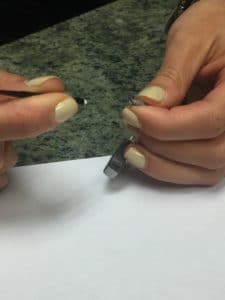

Now, turn the removal stick to the other side (that has the new white end on it) and insert the new white end into the sound outlet and remove. Make sure the wax guard is sitting flat against the stainless steel bushing of the sound outlet.
All that’s left to do is throw out your old wax guard and removal stick, which can’t be reused. And you’re done! Are you hearing better now?

About the Author: Dr. Ronna Fisher, AuD, CCC-A, FAAA is the founder and president of Hearing Health Center, which she established in 1984 in memory of her father, who suffered from untreated hearing loss and died at 53. That personal loss has shaped her entire career. Under her leadership, Hearing Health Center has been voted the best hearing practice in Illinois three years in a row by Hearing Review. In 2005, she expanded her mission by founding the Fisher Foundation for Hearing Health Care, a nonprofit dedicated to making auditory care more accessible. Dr. Fisher earned her doctorate in audiology from the Pennsylvania College of Optometry and holds a Certificate of Clinical Competence in Audiology (CCC-A) from the American Speech-Language-Hearing Association. She is a Fellow of the American Academy of Audiology and a member of the Academy of Dispensing Audiologists.
Recent Posts
- Itchy, Itchy Ears: Common Causes and Solutions
- 4 Common Myths About AI in Hearing Aids
- Crackling in Ear: What Does it Mean and How to Treat It
- How to Keep a Little Hearing Loss from Becoming a Big Deal
- What Untreated Hearing Loss Costs You
- EXTRA, EXTRA: Dr. Ronna Fisher Made the Cover
- Medicare Made Easy… Should You Switch Plans?
-
Downtown Chicago
Magnificent Mile
142 E. Ontario St, Ste 1100
 (312) 263-7171
Learn More
(312) 263-7171
Learn More
-
Naperville
Fox Run Square
1212 S. Naper Blvd, Ste 103
(630) 369-8878
Learn More
-
Oak Brook
Oakbrook Prof. Bldg.
120 Oakbrook Ctr, Ste 709
(630) 571-7111
Learn More
-
Highland Park
Crossroads Shopping Cntr.
185 Skokie Valley Rd.
(847) 681-7000
Learn More
-
Park Ridge
Presence Resurrection
7447 W. Talcott Ave, Ste 360
(773) 466-8878
Learn More