
Hearing aid prices vary widely, making the price range unhelpful as a decision-making tool.
A 2025 clinical trial tested this directly by comparing a $4,400 hearing aid against a $1,100 one from the same manufacturer in the same study and found no meaningful difference in performance.
The largest differences in hearing outcomes were associated with comprehensive professional fitting and follow-up care rather than device price. Before you spend any money on hearing aids, let’s get into what you might be paying for.
What Hearing Aids Actually Cost Right Now
Depending on where you’re looking, the quoted price for a hearing aid can include anything else bundled with it.
There are three categories: self-fitting over-the-counter (OTC) devices, preset OTC devices, and prescription or professionally fit devices.
The prices for all three vary based on your location, health insurance, and provider.
What’s more important than the price itself is knowing what else is included. Prescription pricing oftentimes bundles in the professional fitting appointment, one or more follow-up visits, and ongoing maintenance.
OTC pricing generally does not, because there’s no professional involved to bundle in.
That single distinction accounts for a large share of the spread you’re seeing.
When hearing aid coverage is available, it is more commonly applied to professionally fitted prescription hearing aids than OTC devices.
Why the Range Is So Wide
The technology in your hearing aids is part of it, as are the services attached to your purchase.
Brand and features matter with each offering: basic, mid-level, and advanced technology tiers, with advanced tiers costing more.
What often gets left out of the conversation is that OTC devices can be priced so much lower because they remove the services an audiologist or hearing aid specialist offers.
That means no fitting appointments, no fine-tuning, and no follow-up visits.
Removing everything an audiologist offers changes what you’re actually buying. The study found that comprehensive professional fitting and verification had a greater impact on outcomes than moving from a lower-priced to a higher-priced technology tier.
Price vs. Care
Researchers at the University of Iowa and Vanderbilt University Medical Center ran a randomized trial involving 245 people aged 55-85, all with mild-to-moderate hearing loss and no prior hearing aid experience.
They split participants across combinations of device tier and service model: a high-end device (around $4,400 a pair) or a low-end device (around $1,100 a pair), from the same manufacturer, paired with one of three levels of support: full audiologist-fitted care, limited audiologist support for an OTC-style preset device, or no professional support at all.
The biggest finding was that the group with full audiologist care did meaningfully better than either OTC-style group. These participants could hear better and ended up wearing their devices more consistently.
One specific note was that the group with professional help still ran into acoustic feedback problems that switching between presets couldn’t resolve.
Fixing it required probe-microphone measurements, a technique that checks the actual sound reaching the eardrum, and the flexibility of professional fitting software to adjust accordingly.
A preset device doesn’t have access to that tool set.
The trial proved that price alone was a poor predictor of outcome, and that the gap between “some support” and “full support” mattered.
What Professional Care Looks Like
A hearing aid fitting usually includes follow-up visits and adjustments to ensure your hearing aids are effective.
This includes an in-person fitting, tests to ensure your hearing aids are delivering the right sounds to your ears, and a follow-up visit within the first few weeks to catch anything that isn’t quite right yet.
Expect ongoing adjustments as your hearing or your life changes.
That first follow-up matters more than people expect. As you move around from different locations and sound profiles, you may experience gaps in your hearing aids. An adjustment is based on what you report to your audiologist to help close any gaps you might have.
OTC hearing aids generally do not include the same level of individualized fitting, verification, and follow-up care that accompanies professionally fit prescription hearing aids.
What to Ask Before You Buy
Always compare what’s included versus just the price of the hearing aid.
Before you commit to anything, here are some questions to ask yourself and your hearing aid specialist.
- What’s included in this price? Is it just the device, or the fitting and follow-up too?
- Is there a trial period, and how long does it run?
- What does the warranty actually cover, and for how long?
- How many follow-up or adjustment visits come with this, and what happens after that runs out?
- And if your hearing or your fit changes a year from now, what’s the plan?
If you’re trying to figure out what actually makes sense for your hearing and your budget, come in and see us.
Schedule Your Hearing Aid Fitting Today
Are you struggling with your hearing? Hearing Health Center offers complimentary baseline hearing tests for anyone seeking more information.
If you’re in need of hearing aids, our team of audiologists is experts in fitting, tuning, and adjusting to make sure your hearing aids work for you. We offer all major brands and tiers.
Schedule your hearing aid appointment today at any of our five locations.
As more and more people turn to over-the-counter hearing aids, misinformation about them is increasing.
While not for everyone, if you are looking to purchase OTC hearing aids, there are a few considerations.
Our guide provides you with the critical information you need to make the right decision about your hearing aids.
What To Evaluate Hearing Aids On
When looking for a pair of hearing aids, there’s a lot to consider. How they fit and how they sound are just some of the criteria I use when making suggestions to patients about their next pair.
Before offering any options, here are the 13 factors we consider for your hearing aids:
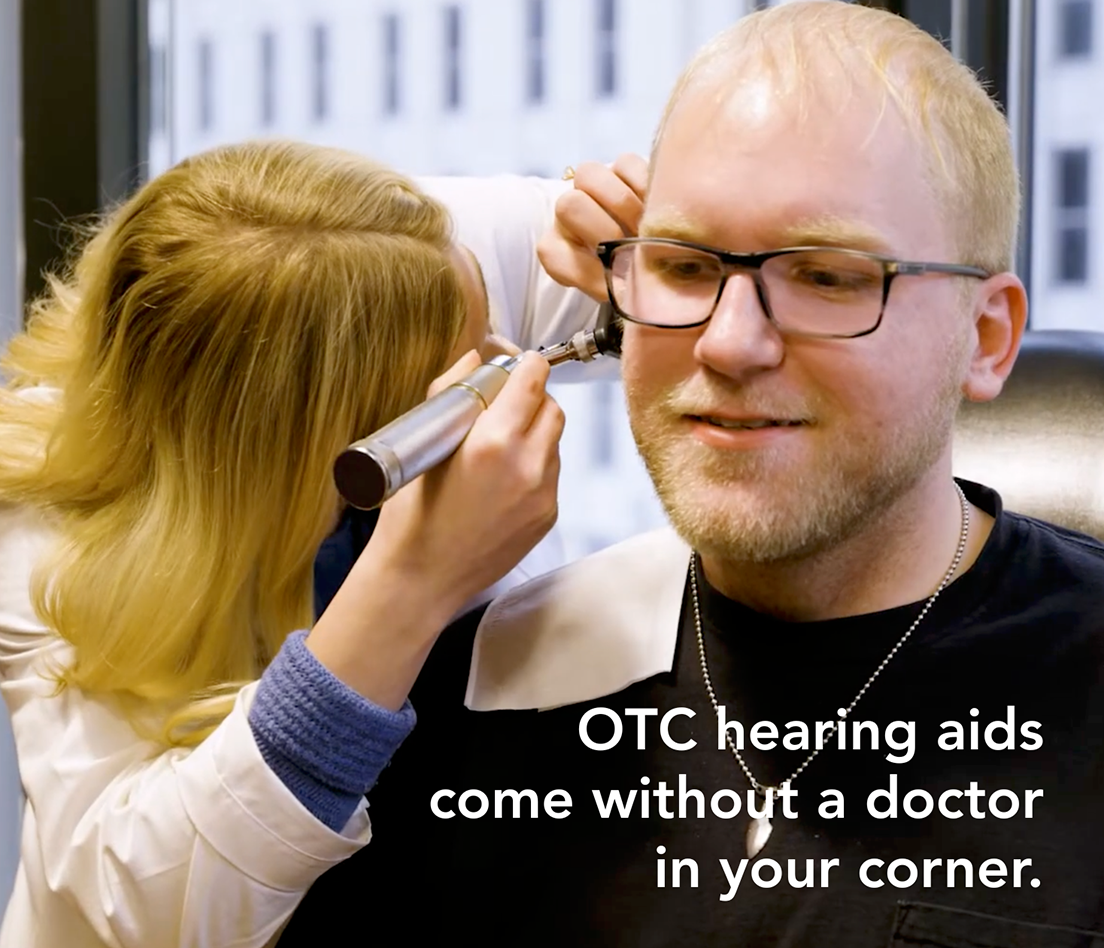
1. Speech understanding (most important). People want to hear people, not just sounds. If you cannot be part of the conversation because of your hearing, then your hearing aids aren’t working as they should.
2. Evaluate speech understanding in various environments (moderate noise, heavy noise from behind, groups). Different locations require different settings for your hearing aids. If they aren’t adaptable, they might not be your best choice.
3. Evaluate clarity, ease of understanding, and listening effort. When wearing hearing aids, it shouldn’t be a struggle to understand what people are saying.
4. Noise management. We need to see how quickly your hearing aids adapt to environmental changes. Does noise overpower the ability to understand? This is an important element to consider before purchasing.
5. Sound quality. Simply, how do they sound listening to music, to TV, to everyday sounds (footsteps, paper)? Is it clear? Fuzzy? If the sound quality isn’t great, then look for other options.
6. Comfort and physical fit. If your hearing aids are not comfortable or do not fit perfectly, the “best” hearing aids will fail. That’s where working with an audiologist is so important. Our team works with you to ensure your comfort levels and fit align to get the most out of your hearing aids.
7. Streaming and connectivity. This is where many products fail. How do your hearing aids sound on the phone? Do they drop calls? How do they handle streaming music and switching devices?
8. Customization and flexible fitting allow us to assess fit, tinnitus features, and adjustments for specific needs. The less flexibility, the fewer options you have to make the hearing aids work for you.
9. Feedback. Do the hearing aids whistle when talking, eating, or wearing a hat? That could make things annoying and difficult to hear.
10. App features matter a lot these days. Depending on the brand, it’s important to consider what adjustments the patient controls – volume, programs, customization, and the learning curve for older or non-techy patients.
11. Battery life, like how long will the battery last in quiet and with streaming? How long do they take to charge?
Purchasing a set of OTC hearing aids doesn’t pair you with a doctor who knows the ins and outs of what makes a set great. That’s why it’s so important to work with an audiologist when making this important decision.
What are the Major Risks of OTC Hearing Aids?
Over-the-counter (OTC) hearing aids can be genuinely helpful for many people, but they are not risk-free. As an audiologist who has worked with patients and hearing aids for decades, I’ve seen firsthand the benefits of custom fitting and adjustments for a better hearing experience.
One of the major risks of purchasing OTC hearing aids is that without a professional diagnostic evaluation, you may overlook serious medical issues and delay proper treatment. Hearing aids might not be the solution to your problems.
Some potential issues include:
- Earwax blockage
- Ear infection
- Fluid in the ear
- Sudden or one-sided hearing loss
- Tinnitus caused by something serious

No audiologist means no fine-tuning for your specific needs and hearing profile.
Another risk factor is the adjustments you make on your own. Some sounds may be over-amplified, which can worsen hearing damage. Other sounds may be under-amplified, making the device useless.
That’s the quickest way for your OTC hearing aids to end up in the trash.
Plus, your hearing won’t always stay the same. If there’s no adjustment to your devices as your hearing changes, then you risk a poor hearing aid experience.
Don’t forget about fit. If devices do not fit properly, it can cause:
- Ear canal irritation
- Soreness or pressure
- Moisture buildup that leads to infections
That’s not to say OTC hearing aids aren’t good products, but they can lead to more serious problems if not addressed early.
What to Expect When Adapting to OTC Hearing Aids?
Over-the-counter hearing aids are not programmed, customized, or fine-tuned to your hearing configuration, lifestyle, or needs.
Therefore, adaptation will take longer.
The first suggestion is to ease in. While this is true for all hearing aids, it’s important still. Your brain has not heard many sounds in a long time; it takes time for your brain to accept and normalize them.
Start in quiet environments and one-on-one conversations. Gradually try small groups, and then noisy places.
Also, be consistent. Your brain adapts through repetition, so if you’re not using your hearing aids, you will never get used to them.
Focus enough time on fit. Hearing aids should fit well and be comfortable.
You should stop and get help if:
- You feel any pain or pressure.
- Your hearing gets worse.
- You get ringing in your ears.
- There is a big difference in the way you hear between your ears.
- There is no improvement in your hearing.
It generally takes 1-2 months to fully adapt to amplification. If you are still struggling after 4-6 weeks, it means the settings are not right, or the aids are not a good match for you.
Want A Better Hearing Aid Experience? Book Online With Hearing Health Center.
The audiologists at Hearing Health Center want to help you have a better experience with your hearing aids. Book an appointment online, or call any one of our five Chicagoland locations for a hearing test, hearing aid fitting, and so much more.
You’ve noticed it for a while now. The TV volume rattles the windows. The “huh?” and “what?” have become their own conversational soundtrack. The way family dinners have quietly reorganized themselves around the one person who can’t quite follow along.
You love this person, and you are losing your mind.
So you bring it up, and somehow, within thirty seconds, you’re in a full argument about something that happened in 2011.
Welcome to the hearing loss conversation. It rarely goes the way you planned.
Here’s what you need to understand before you try again: the person you’re worried about isn’t being difficult. They genuinely don’t know how bad it’s gotten.
Hearing loss is sneaky. It doesn’t show up one morning like a broken arm.
It creeps in over the years, and by the time you’re frustrated enough to say something, they’ve long since convinced themselves that restaurants have gotten noisier, that everyone mumbles now, and that the TV volume is completely reasonable.
Denial isn’t stubbornness. Their brain has been quietly gaslighting them for years, and it’s very good at its job.
Pick Your Moment And Your Words

Timing matters more than you think. Don’t bring this up mid-argument, mid-meal, or mid-anything. Find a quiet moment, one-on-one, when neither of you is already irritated, and lead with love, not logistics.
“I miss talking to you” lands completely differently than “you need to get your hearing checked.” One opens a door. The other reads like a summons.
Don’t say: “You never hear anything I say.”
Do say: “I want to hear your voice, and I want you to hear mine, and lately I feel like we’re losing that.”
Don’t Lead With The Hearing Aids

The minute you say “hearing aids,” a significant portion of the population will mentally check out because what they hear is “you’re old,” “something is wrong with you,” and “everyone is going to notice.”
Which, to be fair, is a lot to absorb before dessert.
So, skip the devices entirely in the first conversation.
Talk about what’s actually being lost: grandkids’ voices at the dinner table, phone calls that have gotten shorter because the connection always seems “bad,” the Sunday night shows they used to watch with you that have quietly stopped.
That’s the real conversation. The appointment with the audiologist is just the next step.
Use Evidence From Their Own Life
Point to the turn signal they didn’t hear.
Mention gently that you said their name three times before they looked up.
Do this without the tone of someone keeping score, which, be honest, is hard when you have been keeping score.
If they push back, skip the debate about whose perception is accurate and suggest a simple baseline hearing screening instead.
Frame it like any other routine health check. You get your eyes checked. You go to the dentist. You let someone look at that mole.
Your ears have been working very hard for a very long time, and they deserve a little attention, too.
Know When To Stop Pushing
You may not win this conversation the first time…or the third time. In my experience, the record is considerably higher than that, and both parties had aged visibly by the end.
Planting the seed matters, though.
Saying something once, calmly, with love, is more powerful than a weekly campaign. They heard you. The irony of that sentence is not lost on me. But they did. Give it time.
Sometimes it takes a grandchild saying, “I want to tell you something, and I really need you to hear me.” Sometimes it takes a doctor mentioning it offhandedly in an appointment. Sometimes it takes one bad moment at a wedding, when they feel completely cut off from everyone they love, for them to come home quieter than usual.
Your job isn’t to force the decision. Your job is to make sure they know you’re asking because you love them, and that when they’re ready, you’ll be right there.
A Note For The Person This Is Actually About
If someone handed you this article, it’s because they love you. They want you at the table, fully present, not nodding along and hoping for the best.
Getting your hearing checked takes about an hour. You’ve spent more time than that looking for your keys.
Your hearing health matters, and the choices you make about hearing aids affect not only your day-to-day living but also your long-term cognitive health.
As hearing technology improves, so do the buzzwords. Recently, there’s been a lot of noise about AI in hearing aids, and it’s important to understand what it means, how it affects your hearing aids, and why you may (or may not) need it.
Despite AI hearing aids being around for a few years, we wanted to help you separate fact from fiction so you and your audiologist can make the most informed decision possible.
How Does AI Work in Hearing Aids?
At this point, it’s impossible to avoid AI in nearly every aspect of our lives. From live chats with our phones to customized shopping lists at the grocery store, if there’s a way to include artificial intelligence in a product, you’re going to see it.
But did you know that hearing aids have been advertising AI for years?
For hearing aids, AI should be broken into two categories: machine learning and deep neural networks.
About two decades ago, the first hearing aids with AI were introduced to the public. For years, your hearing aids have identified audio patterns in restaurants, conversations, and music to build an internal memory system. Then, when the wearer’s environment matches the learned memory system, your hearing aids automatically apply the right settings for the situation.
In 2021, the first hearing aid with embedded deep neural networks hit the market. DNN’s are trained on massive datasets of real-world sounds to mimic the human brain, eventually separating sound from speech to provide a clearer hearing experience.
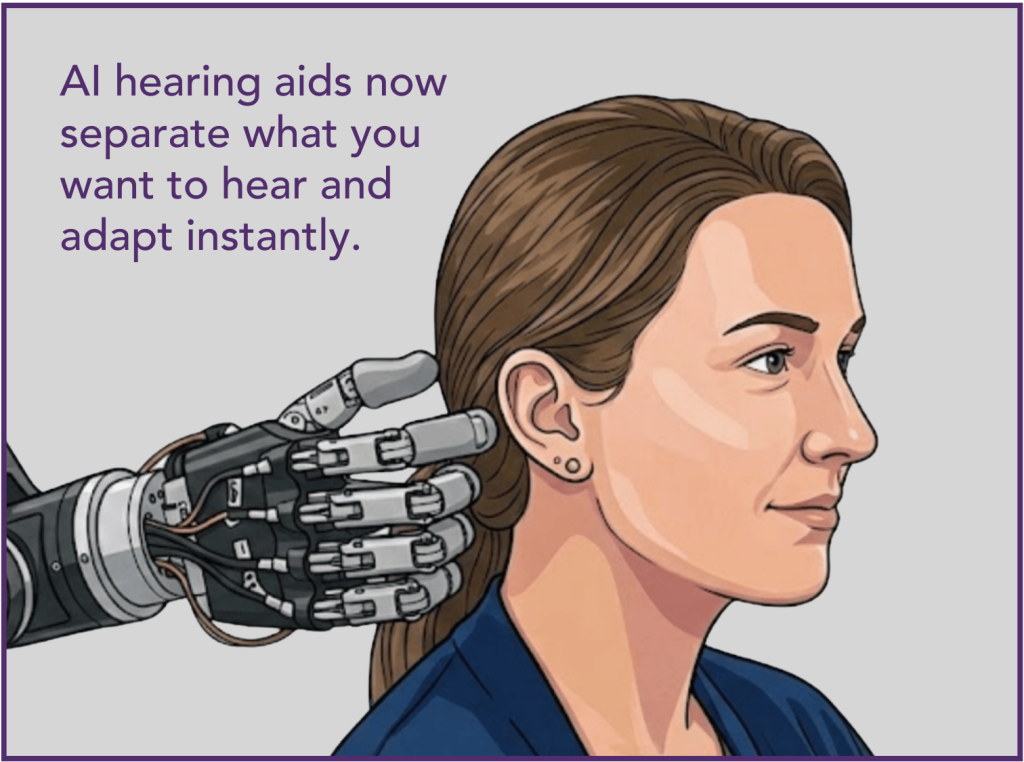
We are at the point where these hearing aids are being trained on tens of millions of sound samples and spoken sentences, creating a better-than-ever sound experience.
At this point, hearing aids with AI intelligently separate what you want to hear versus what you don’t. The AI continuously analyzes your environment to adapt in real time to patients’ needs.
A March 2024 study found that DNN-powered noise reduction outperformed traditional noise reduction techniques, and a 2025 follow-up field research study found that DNN improved interference control. For patients with cognitive load and mental fatigue that lead to conditions like Alzheimer’s, DNN-powered hearing aids are a welcome relief.
Some AI-powered hearing aids also allow audiologists to make remote adjustments to your devices based on patient feedback or data collected on the device. If you’re travelling or live far away from your audiologist, this ensures you get the essential fine-tuning you need for the best experience with hearing aids.
That being said, not all AI hearing aids are the same. Only a few products on the market offer real-time AI processing, which means it’s even more important to work with your audiologist to identify the best hearing aids for your situation.
4 Common Myths About AI in Hearing Aids
With “AI-powered” marketing language all around us, it’s harder than ever to understand what’s real and what’s fake when it comes to your hearing aids. Here are some of the most commonly believed myths and what the evidence actually proves.
Myth: All AI hearing aids think and adapt in real-time while you wear them.
The reality is that most hearing aids use AI during the development and training phase (i.e., before you purchase them), not while you wear them. There are a few products that offer real-time AI processing, but for the majority of hearing aids on the market, all of the AI tools are developed before your purchase.
But that isn’t a bad thing, as the AI algorithms are genuinely effective in providing an excellent hearing aid experience.
Myth: AI hearing aids automatically fix my hearing without the need for an audiologist.
The diagnostic experience and fine-tuning that comes from working with an experienced audiologist is the difference between a good and a bad experience with your hearing aids.
Audiologists ensure everything fits correctly and that the hearing aid is programmed correctly for your specific hearing loss.
Myth: More AI features mean better hearing.
Studies and tests show that while AI features work well, they aren’t universally better in every situation. Those with quieter daily routines probably don’t need adaptive technologies, unlike folks working in more chaotic sound environments.
As with any hearing aid, work with a trusted audiologist to ensure you get the right hearing aid for your sound environment.
Myth (mostly: AI hearing aids are always listening to my private conversations.
AI-powered devices use strict security measures to protect your personal information, with many newer hearing aids processing data on the chips themselves rather than sending audio to the cloud.
But one study revealed that hearing aids were broadcasting patients’ names over Bluetooth without users’ ability to change them. There are also some inconsistencies in how data is governed. Our recommendation is to ask your audiologist about how your data is stored, processed, and shared.
Do You Need AI In Your Hearing Aids?
When surrounded by AI marketing, the question becomes, “Do you need AI for your hearing aids too?”
The answer, unfortunately, isn’t as simple as yes or no; the truth lies in what environments you spend your time and what sort of hearing problems you have.
Almost all research universally agrees that AI in hearing aids helps with noise reduction, specifically in situations where you need to understand what someone is saying over competing background sounds.
A 2025 study published in Frontiers in Audiology and Otology evaluated DNN-based processing across seven real-world acoustic environments, including bars, restaurants, shopping malls, and construction sites, finding measurable improvements in both speech recognition and listener preference when AI-based noise reduction was active.
If these hearing aids reduce cognitive load, there’s a good chance they will positively affect brain health outcomes. When a hearing aid reduces the strain of processing sound in noise, it potentially frees up cognitive resources.
Modern AI-powered hearing aids provide an effortless listening experience, reducing the strain often associated with hearing in complex environments. For anyone at risk, these new AI-powered hearing aids can help reduce the risk of cognitive decline.
For people dealing with mild hearing loss or who spend most of their time in quiet environments, the most advanced AI isn’t as important. A well-fitted and adjusted hearing aid will deliver just as good outcomes.
Fit and Adjustments Are The Most Important Factors
More than any new technology, the most important factor in your hearing aid experience comes from the tuning, fitting, and adjustments your audiologist makes.
At Hearing Health Center, our audiologists have decades of experience working with patients of all ages, helping them get the most out of their hearing aids. When your hearing aids fit correctly and volumes are just right, you’re much more likely to continue wearing your hearing aids.
That’s why we always recommend coming to any of our five locations for fittings, adjustments, and to get any questions you might have about your hearing aids answered.
Having Trouble Hearing? Schedule Your Appointment at Hearing Health Center Today.
Having trouble hearing during conversations? Feel like social gatherings are getting harder and harder? Book your appointment online with Hearing Health Center for a free comprehensive hearing exam. An audiologist on staff performs a full exam and provides you with the information you need to get your hearing back on track.
The ear is a dark, warm, moist place…the perfect environment for growing fungi, germs, and bacteria. Hearing aids reside in this environment 13 to 16 hours/day.
Guess what? Every time you remove your hearing aid from your ear, it is loaded with fungus, germs, and bacteria.
Reinserting your hearing aids without cleaning, sanitizing, and disinfecting them can irritate the lining of your ear canals, leading to redness, swelling, itching, pain, unpleasant odors, and infections.
Here are our best tips on how to clean and disinfect your hearing aids.
Do I Have To Clean or Disinfect My Hearing Aids?
There are three key reasons why you should always clean and disinfect your hearing aids:
- Protect your ears
- Upkeep for optimal performance
- Avoid broken parts
A hearing aid, similar to an earbud or any type of headphone that sits in your ear, collects earwax, dirt, dust, and debris over time. While little bits of that won’t hurt, over time, all of those materials mixed within your ear can lead to ear infections and skin irritations.
Long-term, you might experience other ear-pain-related issues, all because you didn’t clean your hearing aids.
Like most electronics, the better you take care of them, the better they’ll work. Hearing aids are no different.
To maintain your ability to hear and the clarity with which sound comes through your hearing aid, you must clean it regularly. Debris (especially earwax and moisture) clogs microphones, receivers, and vents.
And of course, when your hearing aids start to break down, they just won’t last as long. Well-maintained hearing aids can last anywhere from 3 to 7 years, but if you aren’t keeping up with cleaning, that time will shorten quickly.
While Hearing Health Center is always ready to help with any repairs you might need, we also want your hearing aids to last as long as possible to save you money and protect your hearing.
How To Clean Your Hearing Aids
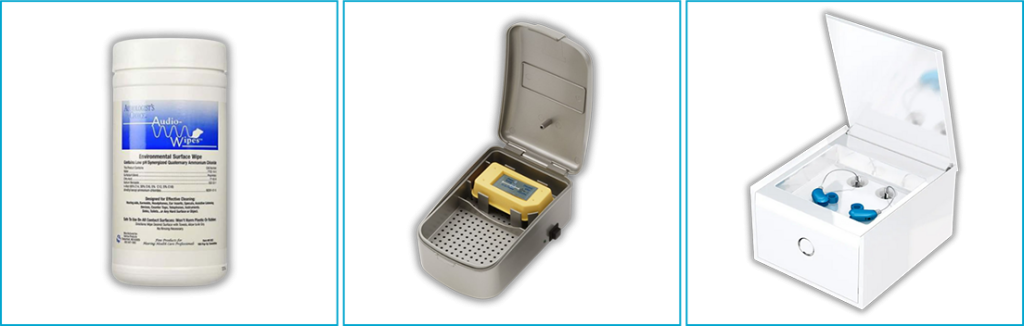
Step 1: Wipe with a non-alcohol sanitizing wipe (like Audio Wipes).
Step 2: Keep your hearing aids in a drying system (Dry and Store) or the new (PerfectClean) explicitly designed to sanitize and pull out the moisture inside the hearing aids that accumulated from your ear.
Drying systems utilize desiccants and heated, moving air to dry the hearing aid both inside and out. The built-in ultraviolet light sanitizes and kills germs while removing moisture.
Using a drying kit will:
- Increase the life of your hearing aids
- Prevent costly repairs
- Increase battery life
- Maintain the peak performance of your hearing aids
- Relieve itchy ears by killing germs
**Pro Tip!** Never use alcohol on hearing aids or ear molds. It will ruin and erode the surfaces and special plastic materials used in the manufacturing process. Alcohol will also damage the delicate components of the hearing aid.
What NOT To Do When Cleaning Your Hearing Aids
1. Do NOT use household cleaning products to clean hearing aids.
It might be tempting to grab something underneath your sink to clean out your dirty hearing aids, but let me stop you there.
Not only could the chemicals cause your hearing aids to malfunction, but certain products may also harm your ears.
Instead, stick to cleaning products specifically designed for use with hearing aids. If you have any questions, don’t hesitate to ask a member of the Hearing Health Center team.
2. Do NOT use sharp objects to clean hearing aids.
The products around your house, such as pins, needles, or even pencils, should never be used to clean something out of your hearing aids.
If an object is sharp, you have a good chance of puncturing and scratching the inner workings of your device, which increases the likelihood of breakage.
3. Do NOT submerge hearing aids in water to clean them.
We know it sounds obvious, but hearing aids are not waterproof. They might be water-resistant, but that isn’t the same thing. Instead, use a damp cloth with hearing aid-specific cleaning products to wipe them down.
4. NEVER use compressed air to clean hearing aids.
Your hearing aids are fragile, so a single blast from a can of compressed air could cause a lot of problems. The power is too much for the inner workings of your hearing aids to function, so whatever you do, do not use compressed air.
Need Help with Your Hearing Aids? Call Hearing Health Center Today.
Whether your hearing aids need tuning up or you’re in the market for a new pair, the team at Hearing Health Center has you covered. Our experienced audiologists conduct a comprehensive hearing exam to ensure your hearing aids are a perfect match for your needs.
Don’t delay; call Hearing Health Center or schedule an appointment online today.
We live in a digital age. With a click of a button, you can download your favorite movies. You can order the latest clothing trends.
You can even have your groceries delivered right to your door. So what about having your hearing aids delivered to you? Sure, the convenience and relative ease might be convincing.
But how do you know you’re really getting the hearing help you need?
The Convenience of Online vs. The Value of Professional Hearing Care
The hearing industry has experienced tremendous growth over the last 25 years.
We no longer see the “big beige bananas” earphones that plagued those with hearing problems in the past.
Now, hearing aids are small, discrete, and more technologically advanced than ever.
But you wouldn’t buy a pair of glasses without knowing your prescription, would you? The same principle should apply if you’re purchasing hearing aids.
The difference maker between online purchases and in-office ones is the trained Doctor of Audiology, who fits and sets up the hearing aids.
Unless your hearing aid is programmed directly for your needs—your physical ear, your lifestyle, your audiometric hearing loss—you won’t be getting the hearing help you need.
Instead, you’ll be left to figure it out yourself, leading to a lackluster hearing experience.
Why Professional Diagnosis is Non-Negotiable for Your Hearing Health

When it comes to your hearing, a professional diagnosis isn’t just a recommendation—it’s non-negotiable.
Why?
Before we even think about hearing aids, our Doctors of Audiology perform extensive testing to pinpoint the exact cause of your hearing problems.
Hearing loss isn’t always as straightforward as needing a volume boost.
Sometimes, hearing loss can be something easily treatable, such as a simple buildup of earwax. Other times, it’s a sign of a more serious medical issue.
You don’t and can’t know on your own.
Plus, without a medical diagnosis, you could end up spending a significant amount of money on a hearing aid you don’t even need.
We don’t want our patients to fall for the trap of an online solution when what they truly need is a precise and professional diagnosis.
The Role of Your Audiologist
There are four key roles your audiologist takes on when you come in with hearing problems: diagnosis, programming, fitting, and repairs.
At one of your first appointments, and before ever discussing hearing aids with you, Doctors of Audiology perform extensive testing to determine the root cause of your hearing problems. These simple tests are comprehensive and enable you to gain a thorough understanding of your current hearing health.
Without a doctor’s diagnosis, you could be scammed into paying for a hearing aid online that you do not need.
Once we’ve discussed your hearing aids, your audiologist will take the time to assist you in programming them.
Remember, hearing aids are not just volume controls.
Hearing aids have to be specifically programmed to help you hear the sounds you are missing.
Without a comprehensive test, even the best hearing aids can’t help you because they won’t be programmed to your needs.
Of course, you also want the right fit for your hearing aids. These must always be customized to the specific user.
If you purchase hearing aids online, there is no guarantee that they will fit your ears properly.
And in the unlikely event that something breaks, like any piece of equipment, your audiologist has the capabilities to repair and assist with any issues you might encounter.
Rather than having to fill out online forms or mail your hearing aids, Hearing Health Center can help you right away.
A Personalized Approach to Hearing Health

Your ears are as unique as your fingerprints, and your hearing loss pattern is entirely individual.
This is precisely why a personalized approach to hearing aid fitting and programming is a crucial step in your hearing health journey.
Without custom programming based on a comprehensive audiometric test, even the most advanced hearing aid technology will fall short.
It would be like trying to navigate a complex city with a generic map when you need a detailed GPS.
A personalized approach means your hearing aids are an extension of you, not a one-size-fits-all solution.
Is an Online Bargain Truly a Better Value?
While a pair of online, over-the-counter hearing aids might retail for anywhere from $300 to $2,000, professionally fitted prescription hearing aids, which often include comprehensive services, are a bit more expensive.
At first glance, that price difference feels substantial.
But remember, that online “bargain” often doesn’t account for crucial elements like a professional diagnosis, custom programming tailored to your unique hearing loss, or personalized fitting for optimal comfort and effectiveness.
These aren’t just “add-ons”; they are the foundational pillars of successful hearing aid use.
Without a proper diagnosis, you may purchase an unnecessary device or one that fails to address the root cause of your hearing issues, resulting in wasted money.
If the fit is poor, you’ll experience discomfort and likely won’t wear them consistently, rendering your investment useless.
Is it really a bargain if you’re not hearing your best?
Ready to Improve Your Hearing? Call Hearing Health Center Today!
Want to experience the difference by working with Hearing Health Center? Our team delivers comprehensive, high-quality exams to ensure your hearing aids are the right match, fit, and sound for you.
Schedule your free examination to start hearing better today!
Hearing aids, like all electronic or mechanical devices, require routine maintenance. Otherwise, sounds become muffled or – in the worst-case scenarios – fail altogether.
Regardless of the style of hearing aid you have, they are all electronic devices that are placed in a sweaty, waxy, and moist environment for an average of 18 hours a day. That means gunk and dirt from your ears enter the hearing aids, causing malfunctions and unnecessary costs.
That’s why daily hearing aid cleaning and maintenance is important. With decades of experience, we’ve compiled the following tips to help keep your hearing aids working under the toughest of conditions.
Why Hearing Aid Maintenance Matters
Hearing aids improve the quality of life for anyone struggling with their hearing health. A 2022 study reported 80% of hearing aid owners are satisfied with their devices, and 64% acknowledged that hearing aids have improved the quality of their lives.
Despite that, a 2013 research paper identified that 80% of adults aged 55–74 years who would benefit from a hearing aid do not use them.
Some of that is due to poor fits or broken hearing aids, but there’s a portion of the population that struggles with the daily maintenance required to keep their hearing aids working properly. They might wear their hearing aids for a few months, then stop once the maintenance becomes too much.
But it’s important to note that hearing aids are electronic devices. Just like any other device in your home, they are susceptible to gunk, earwax, and dirt. Sensitive components, such as microphones, receivers, amplifiers, and batteries, are all vulnerable to moisture and ear buildup.
Regular upkeep helps prevent repairs and keeps your hearing devices functioning better and longer.
It’s not just about protecting your hearing aids, it’s about maintaining a healthy quality of life.
7 Tips to Keep Your Hearing Aids Clean

1. Wipe Down Your Hearing Aids
This first step you should do at least once a day.
Take out your hearing aid and wipe it down as well as the dome with a tissue or moist wipe.
You can do this first thing in the morning or right before bed to ensure any buildup from the day isn’t still on the electronic parts.
2. Brush Parts of Your Hearing Aid
Your audiologist probably gave you a small brush when you picked up your hearing aids. Use that brush to clean your microphones, receivers, and other parts of hearing aids daily.
If you cannot find the original brush, use a small, soft baby toothbrush as an alternative.
3. Change Your Wax Guards
Hearing aids that have wax guard systems—check and change at least once a month, or anytime the wax guard is clogged and you’re not hearing well.
If you need to buy new ones, wax guards are available for purchase at all Hearing Health Center locations.
4. Replace Your Domes
Domes should be replaced if they start to become loose or sag, so they don’t become stuck in the ear canal.
Consider changing your domes every couple of months to prevent this from happening.
5. Air Out Your Batteries
Open the battery door at night to turn your hearing aids off and allow air to enter the battery compartment. This limits additional buildup and allows you a chance to clean any dirty areas.
As a bonus, this saves you some battery life.
6. Store Hearing Aids in a Dry Environment
Do NOT store the hearing in a humid environment like the bathroom.
Hearing aids spend most of their day in the humidity of your ear canal, so give them space to breathe and avoid picking up any additional bacteria that may exist due to the humid temperatures.
7. Use a Drying Unit
Place the hearing aids in a drying unit overnight.
Most units have fans to circulate the air, UV lights to kill bacteria, and a desiccant to remove moisture and humidity from the hearing aids. If you don’t have one, get one.
Need Help with Cleaning, Parts Replacement, or Hearing Aid Troubleshooting? Visit Hearing Health Center Today.
The team at Hearing Health Center is on your side and ready to help with all of your hearing aid problems. Schedule a visit with our audiology team today at any of our five locations, and we will work to make sure you never miss a conversation again.
Finally, a hearing aid smartly designed to look and function like an earbud. Unlike traditional earbuds, Signia Active’s proven hearing