
Anyone that has a behind-the-ear hearing aid will use either a dome or a custom mold- this is the piece of rubber or plastic that goes directly into the ear. These pieces of your hearing aid live in a wet, humid environment- so it’s important to know when to change them out! Additionally, sometimes the dome or ear mold just doesn’t fit right, which will not only affect the quality of your hearing, but it will also affect your experience with the hearing aids themselves.
DOMES
 The dome is the rubber tip that sits inside the individual’s ear canal. Domes are usually clear or black, and can range in a wide variety of sizes- one for every possible ear canal! As the dome is the first point of contact with your ear canal, it can very easily become blocked with wax or debris, and prevent sound from coming out of the hearing aid. We see a lot of patients whose hearing aids have “stopped working”- when upon closer inspection, they just need a clean dome! When the dome becomes plugged, you can use a cleaning tool with a brush on the end to brush off any debris or wax. So, when should you change your dome with a new one? You should change your dome if it is ripped or yellow. If you see that your dome is ripped or has turned a yellow color, it is time to visit your audiologist and change your dome- or, change it at home!
CUSTOM EAR MOLDS
Many patients with behind-the-ear hearing aids have custom molds that fit into their ear.
 You may need to get a new ear mold if:
- Your ear mold is not fitting right or coming out of your ear.
- Your ear mold is ripping or very discolored.
- You are getting feedback or whistling from your hearing aid. If your ear mold is not fitting in your ear correctly, sound may be leaking out of your ear and getting picked up by the microphones of your hearing aid.
In any of these cases, call your audiologist to see if it’s time for a new ear impression!
 Technology requires special care during the summer months, and your hearing aid is no exception. You need to maintain your hearing aids as you normally would, but because of the added humidity in the air and the heat of June, July, and August, you’ll need to take extra care when you’re having summer fun. Take care of your investment and your health with these four tips.
Tip 1: Remove your hearing aids before swimming.
Anytime you’re around water, it’s best to leave your hearing aids behind. You do need to consider your own safety though. If you won’t be able to hear warnings, it might be safer to leave them in. If they do get wet, use a lint-free towel to dry them off, remove the battery, and place the aid itself in a hearing aid dryer or desiccant jar.
Tip 2: Protect them against sweat and humidity.
After a workout, remove your hearing aids and wipe them off. Even water-resistant sets are vulnerable to the bacteria which grows faster when it’s hot and humid. Use disinfectant towelettes and a dry and store solution designed to keep your aids clean and dry. Ask your audiologist about getting your set of hearing aids professionally cleaned more often in the summer.
Tip 3: Keep your hearing aids secure.
Summer activities are often much more risky than those you undertake the rest of the year. Use special clips to keep your hearing aids attached to your clothing or your glasses. If something does come out of place, it won’t go too far.
Tip 4: Get hearing aids suited to your lifestyle.
Talk to your audiologist about the style of hearing aid that fits your needs. Hearing aids that reduce wind noise because they sit completely in the ear canal are ideal for golfers. If you wear a helmet that reduces the effectiveness of your aid, your audiologist has solutions. Take care of your expensive equipment by following proper care and use.
Walter Jacobson sits down with Dr. Ronna Fisher of Hearing Health Center.
Visit our website: hearinghealthcenter.com
Scientific evidence shows that there is a difference between what causes problems with hearing speech while in a noisy area versus the causes of problems hearing sound. Exposure to loud noises effects the brains ability to listen selectively to speech. Click here to read more about why you may have problems hearing someone talking in a noisy area, but still have normal hearing.
OR WHY YOU CANNOT UNDERSTAND WHEN YOUR HEARING IS NORMAL
by Dr. Ronna Fisher Au.D. FAAA
“How is your dad?” Jeremy asked his boss sitting across the table at a recent dinner party. “He died,” said his partner. “That’s great. Tell him I said hello.”
Jeremy knew something was wrong from the stricken look on everyone’s face. When his wife leaned over and whispered, “He said his father died.” Jeremy wanted to crawl under the table and disappear. He thought his boss said, “He’s fine.”
Jeremy called his doctor the next morning to get his hearing checked. He was only 42, but this was not the first time Jeremy had misunderstood. He was having more trouble hearing in court, making out what his wife said from another room and sometimes even when he was in the same room.
He was surprised when the doctor told him the tests were normal and his hearing was fine. “You just need to pay more attention,” his doctor said.
Jeremy’s struggle to understand in everyday listening situations is not uncommon. Studies over the last 10 years show that changes and deterioration of auditory processing in the brain begins at age 40. These changes are not detectable on a hearing test.
SO WHAT HAPPENS WHEN YOU TURN 40?
Hearing vs understanding. They are not the same.
Hearing is about loudness. If your hearing goes down, you just make the sound louder, right?
Wrong!
As any wearer of hearing aids knows, making them louder does not make them clearer. Turning up the volume does not mean you are going to understand any better.
Understanding is about processing. Your brain has to sort out, filter and make sense of all the sounds it receives. How does it do that? What does your brain need so you can understand clearly?
- Temporal Processing – the rate at which we can process auditory information. The ability to follow rapid changes in speech, music and other sounds.
- Have you ever thought that kids talk too fast? They are on their third sentence and you are still processing the first one. Kids do not talk any faster than they always did. Your temporal processing has slowed down.
The slower your temporal processing, the more time you will need to understand what someone is saying.
- Working Memory – the mental sticky note we use to temporarily store and use information. Often used synonymously with short-term memory, working memory is critical for learning, reasoning and decision-making.
- When you have difficulty understanding, your brain has to concentrate more and listen harder. You brain is so intensely focused on trying to understand, that it does not have the resources to transfer the information to your memory. Therefore, even if you “get it” your brain cannot store it.
- Auditory Distraction – irrelevant sounds that break through your attention and focus and impairs your cognitive function.
In order to participate in a conversation, especially in a difficult listening environment, your brain has to separate all of the incoming sounds and focus on one of them.
Beginning at around age 40, the brain cannot filter out distracting information as well as it used to. The ability to encode and retrieve words severely erodes in “background babble.”
WHAT CAN YOU DO?
While you cannot change Mother Nature, there are a few things you can do to help you understand more clearly
- If you can, turn off the TV, Radio, Music and any other distracting sounds
- Eyes help make up for what the ears miss. Try to face and look at the person with whom you are speaking
- In restaurants, try to sit in a booth or a table where you are facing the wall and the noise is behind you.
- Hearing aids and PSAP’s (Personal Sound Amplifying Products). The solution for most people with a hearing problem, attention deficit disorder, or focus issues, is usually to make the signal (speech) louder than the noise or distraction. Amplifying the speech, even when hearing tests are normal, allows for easier listening and less distractions.
Increasingly, hearing aids and the lower cost counterparts, PSAP’s (which are not intended to correct hearing but make sound louder) are being fit and worn to use in those distracting and difficult situations or anytime when understanding clearly is a problem.
 Dr. Ronna Fisher, Au.D., FAAA, Founder and President of Hearing Health Center
Dr. Fisher received her doctoral degree in Audiology from the Pennsylvania College of Optometry. She is a fellow of the American Academy of Audiology, has earned the Certificate of Clinical Competence from the American Speech-Language and Hearing Association, and is an active member of the Academy of Dispensing Audiologists, American Tinnitus Association, and the Illinois Academy of Audiology.
- – Beck DL. (2015) Invisible Hearing Loss American Academy of Audiology Web site.
- – Fullgrabe C, Moore BCJ, Stone MA. (2015) Age-group Differences in Speech Identification Despite Matched Audiometrically Normal Hearing: Contributions from Auditory Temporal Processing and Cognition. Frontiers.
- – Grose GH, Mamo SK, Buss E, Hall JW. (2015) Temporal Processing Deficits in Middle Age. American Journal of Audiology 24:91.
- – Helfer KS, Vargo M. (2009) Speech Recognition and Temporal Processing in Middle-Aged Women. Journal of the American Academy of Audiology20(4):264-271.
- – Baycrest Centre for Geriatric Care.
- – bit.ly/bg-babble
Earbuds are tiny, lightweight, inexpensive portable speakers. They are by far the most popular choice for private listening.
Harmless, Right?
Wrong!
Twenty percent of teenagers have a moderate to severe, permanent and irreversible hearing deficit usually seen in 70-year-olds. Why? Earbuds!
How Can Earbuds Damage Hearing?
Any sustained sound that exceeds a certain volume level (measured in decibels, dB) will cause hearing damage. Anything over 85 decibels (traffic noise, vacuum cleaner, noisy restaurants) is harmful. It doesn’t matter if the sound is pleasant (music, sporting events) or irritating and cacophonous (sirens, chain saws, lawn mowers).
Any loud sound for a long time kills the tiny hair cells that respond to auditory stimulation and damages the nerve fibers that send those sounds to your brain.
Earbuds makes the problem worse because:
- They are nestled inside your ear canals very close to your eardrum and inner ear.
- The sound is concentrated. Close proximity in an enclosed environment increases power of the sound about 10 times. And it’s aimed right at the organ of hearing.
- Unlike the old Walkman, whose battery died after a few hours, listening devices today (iPods, MP3 players) can remain powered for 24 hours. You can listen for long periods of time without taking a break. The ears don’t have a chance to recover from the onslaught of harmful sound.
Which are Worse: Earbuds or Headphones?
 The short answer is earbuds, because of the deep insertion into the ear canal sending stronger waves that quickly damage the nerve fibers. But headphones today, like Beats by Dre, which are made to fit snugly over the ears and boost the base, can be just as damaging depending on the volume and duration of exposure.
Most MP3 players can produce volumes up to 120 decibels. Listening at that level can cause irreparable hearing loss in less than 15 minutes.
And if you ever have ringing in your ears after loud exposure to sound – it’s too late. Your hearing may recover, but the dead hair cells and nerve damage never will.
Balance disorders are very difficult to diagnose and treat because there is often more than one underlying cause. Knowledge of all the sensory systems that contribute to balance as well as how each system works together and interacts with the brain is essential.
How are balance disorders caused?
- Benign Positional Vertigo (BPPV) – BPPV is the number one cause of all dizziness. It involves intense, brief episodes of vertigo associated with a change in the position of your head, often when you turn over in bed or sit up in the morning.
- Vestibular Neuronitis – inflammation of the inner ear
- Ménière’s Disease – a buildup of fluid in the inner ear
- Vestibular Migraine – dizziness and vertigo that may or may not be accompanied by headaches
- Head Trauma
- Multiple Sclerosis
- Stroke and heart attack
- Slow-growing tumors
- Joint and muscle weakness
- High or low blood pressure
- Viral infections
How are balance disorders diagnosed?
- Case History: one of the most important components in diagnosing balance disorders. Details about the imbalance can often determine which part of the inner ear or brain is involved.
- Diagnostic Hearing Evaluation: the hearing system and the vestibular system are very close in physical proximity. They function together. Any part of the ear can cause and/or contribute to a loss of balance.
- Auditory Brainstem Response: tests both the ear and the brain by measuring the timing of electrical waves from the brainstem.
- Voluntary Eye Movement Testing: measures the ability to coordinate eye movements with head movements crucial for walking, driving, etc.
- Videonystagmography (VNG): computerized testing that measures, records and analyzes eye movements under various conditions.
- Computerized Dynamic Posturography (CDP): measures and tracks all of the components (eyes, inner ear, muscles and joints) involved in maintaining balance.
How are balance disorders treated?
Treatment of balance disorders consists of Vestibular Rehabilitation and Balance Retraining. An individual treatment plan is designed for each patient based upon the patient’s history, the findings from the diagnostic testing performed and the functional limitations caused by the imbalance.
The goals of all treatment plans are:
- Decreasing or eliminating dizziness/vertigo
- Improving balance function and safety
- Improving visual motor control and tolerance of motion
- Increasing activity levels
- Reducing falls or risks of falls
Has your hearing aid ever suddenly stopped working? Most often, you might try changing the battery and then wind up coming in to the audiology office for an appointment. During that appointment, have you been told that your hearing aid was just plugged with wax? Well, I know that I have told many patients this in the past. The great news is that you have the ability to unclog your hearing aid at home by changing the wax guard.
What is a wax guard and why is it important?
Depending on the type and style of hearing aid you have, there is a wax guard located at the sound outlet or at the receiver. The wax guard acts as a protective cover to stop ear wax from going deep into the hearing aid. Typically it is a white circle that is located on the portion of the hearing aid that you insert into your ear.
When should I change my wax guard?
The amount of earwax produced by each individual can vary. It is recommended that we check the wax guard daily. If your hearing aid starts to sound weak/silent or wax is visible, it’s time to change the wax guard.
How do I change my wax guard?
First, wipe off any visible wax from the hearing aid, and make sure you have the necessary wax removal sticks to change it at home.

Next, insert the open ended portion of the removal stick into the sound outlet (usually encompassed into a stainless steel bushing), twist, and pull it straight out.
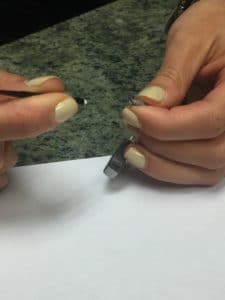

Now, turn the removal stick to the other side (that has the new white end on it) and insert the new white end into the sound outlet and remove. Make sure the wax guard is sitting flat against the stainless steel bushing of the sound outlet.
All that’s left to do is throw out your old wax guard and removal stick, which can’t be reused. And you’re done! Are you hearing better now?
Hearing Health Center presents Experience the “TeleCare” Breakthrough featuring Walter Jacobsen
Hearing Health Center presents Dreading the Holidays featuring Walter Jacobsen