
I HEAR, BUT I DON’T ALWAYS UNDERSTAND
MY HEARING IS FINE… YOU MUMBLE
IT’S NOT THAT BAD
DENY, DENY, DENY
It’s frustrating, aggravating, isolating, depressing, and embarrassing. Pretending to hear when you don’t is exhausting.
SO WHY DON’T YOU JUST ADMIT YOU HAVE A PROBLEM?
Here’s Why
Hearing doesn’t change overnight. It happens over the years, so you don’t realize you’re turning up the volume of the TV louder, that you’re saying ‘what,’ ‘huh,’ ‘pardon me,’ and ‘please repeat that,’ more and more. One day, the turn signal in your car disappeared. You don’t know what day it was. But when you look at your dashboard, you see the turn signal is still on, but you don’t hear it…you don’t even know it’s supposed to make a noise.
Your brain automatically adjusts to reduced hearing by filling in missing sounds and creating workarounds that feel normal.
You convince yourself that restaurants have gotten noisier, that your spouse and kids mumble, that it’s not that bad, and you can get by.
Admitting you have a problem means there’s something wrong with you.
YOU’RE AFRAID TO FIND OUT YOU NEED HEARING AIDS
You think it means you’re old.
- What will people think?
- Will it affect my job?
- Will they think I’m weak?
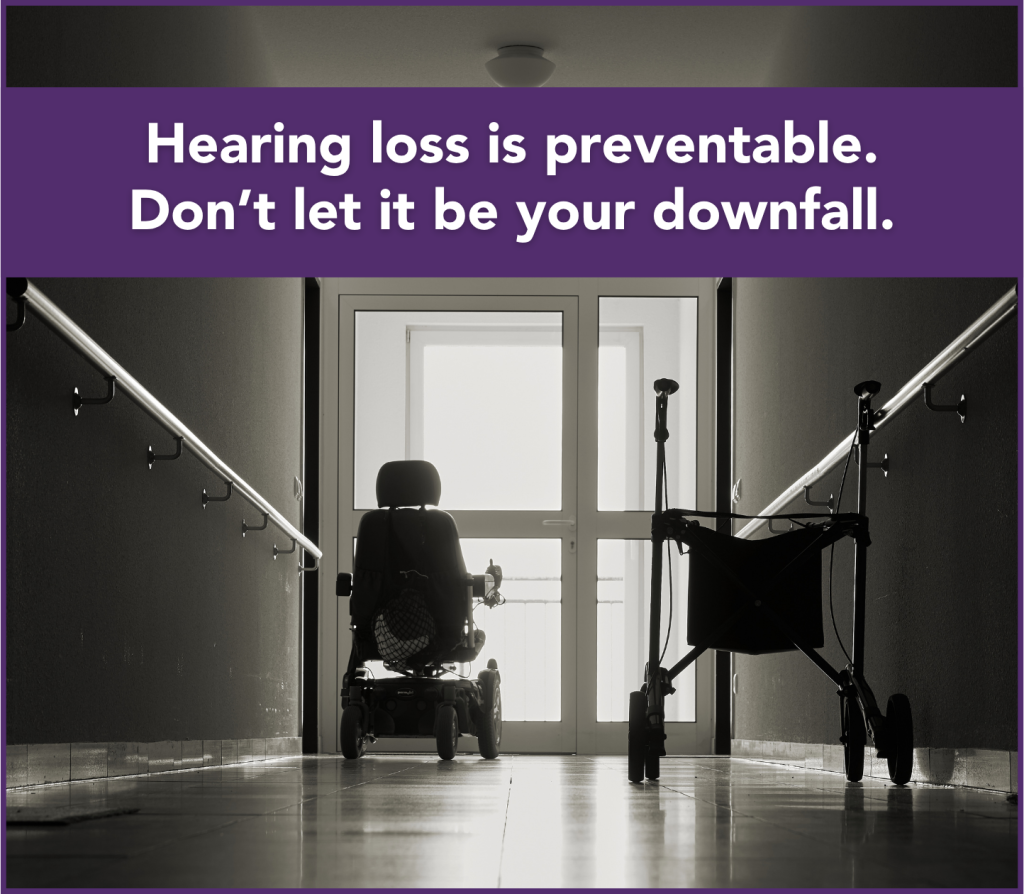
YOU WANT TO LIVE A LONG, HEALTHY LIFE
- You eat right
- You exercise
- You get your blood pressure, cholesterol levels, and vitals checked regularly
- You go to the dentist every 6 months
- You go to the dermatologist to check for moles and growths
- You get your eyes checked regularly
- You look great. Everyone thinks you’re at least 10 years younger than you are.
WHAT’S GOING TO BE YOUR DOWNFALL? WHAT’S GOING TO PUT YOU IN A NURSING HOME?
YOUR INABILITY TO HEAR
What happens to your brain when you don’t hear well?
You have two auditory centers in your brain, a right and a left center. Their main job is to process, interpret, and make sense of the sound they get from your ears. Your ears just collect the sound. It’s your brain that listens.
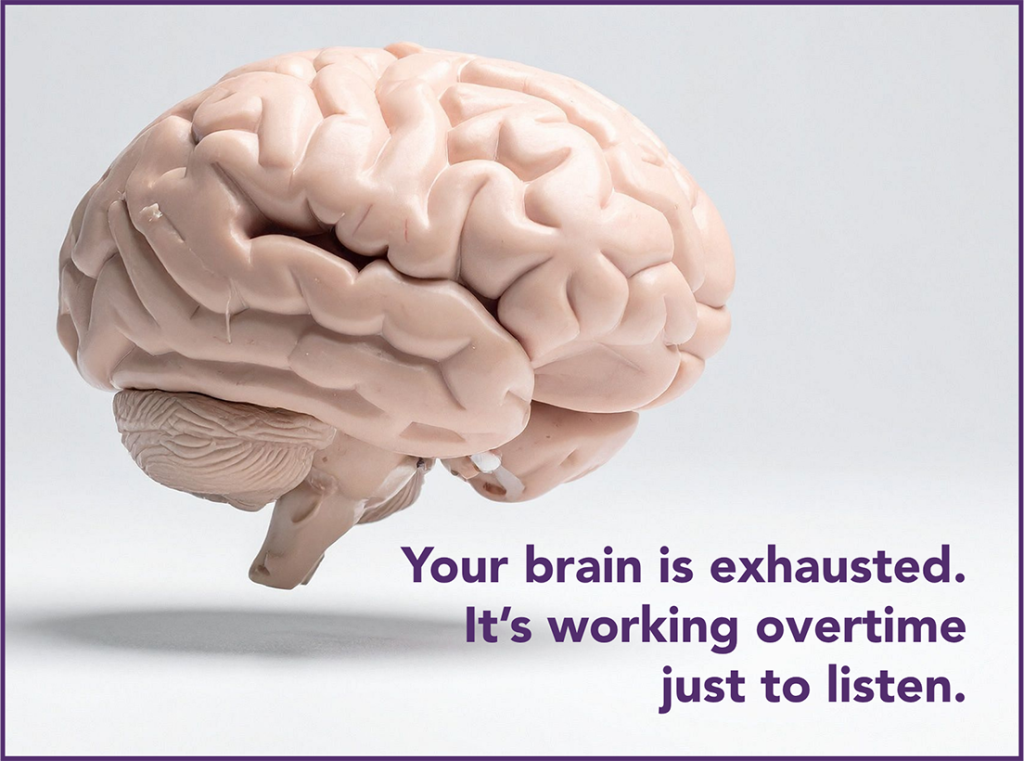
When part of the sound is missing, the auditory centers can’t understand what’s going on. They need help. They get help from the frontal lobe next door. The problem is, the frontal lobe is designed for higher cognitive functions, like memory, problem solving, decision making, and personality. When it’s helping the auditory centers just to listen, it has less ability to help you remember what someone said. It has less capacity to solve problems and make decisions. The frontal lobe starts to decline and deteriorate.
Your brain is exhausted. It’s working overtime just to listen.
At the end of the day, you’re tired, cranky, and you don’t want to talk to anyone.
It’s mentally exhausting, it’s depressing. It’s isolating. It’s stressful. It’s lonely.
If you wait too long, your brain gives up and is permanently damaged.
STOP DENYING
If someone tells you the TV is too loud, or go get your hearing checked, or I’m tired of repeating…
9 times out of 10…you have a problem.
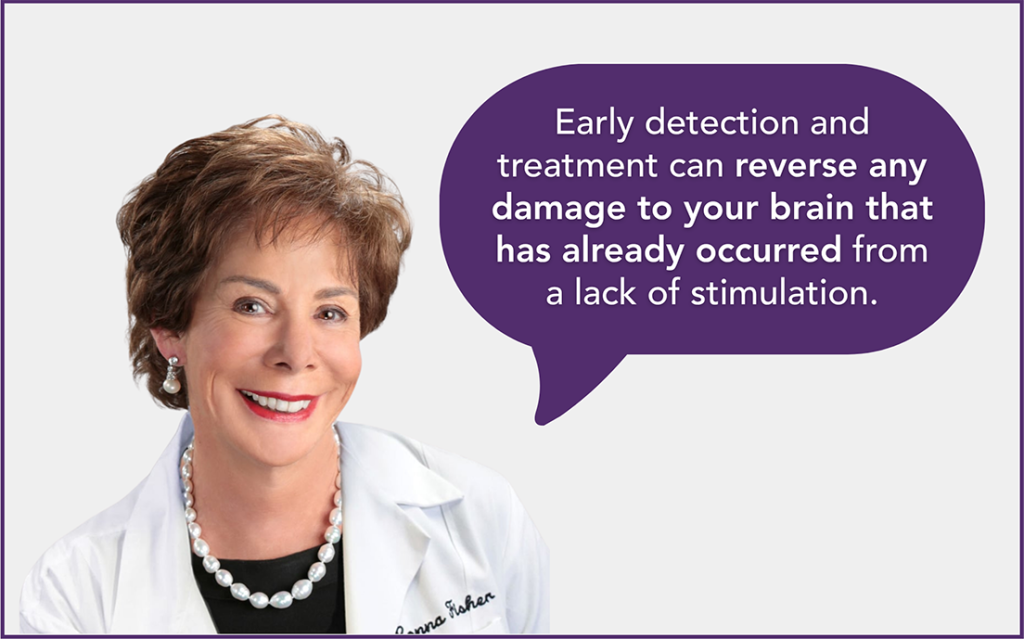
Early detection and treatment can reverse any damage to your brain that has already occurred from a lack of stimulation.
Waiting too long can lead to permanent cognitive damage and irreversible damage.
GET YOUR HEARING CHECKED!
Your hearing health matters, and the choices you make about hearing aids affect not only your day-to-day living but also your long-term cognitive health.
As hearing technology improves, so do the buzzwords. Recently, there’s been a lot of noise about AI in hearing aids, and it’s important to understand what it means, how it affects your hearing aids, and why you may (or may not) need it.
Despite AI hearing aids being around for a few years, we wanted to help you separate fact from fiction so you and your audiologist can make the most informed decision possible.
How Does AI Work in Hearing Aids?
At this point, it’s impossible to avoid AI in nearly every aspect of our lives. From live chats with our phones to customized shopping lists at the grocery store, if there’s a way to include artificial intelligence in a product, you’re going to see it.
But did you know that hearing aids have been advertising AI for years?
For hearing aids, AI should be broken into two categories: machine learning and deep neural networks.
About two decades ago, the first hearing aids with AI were introduced to the public. For years, your hearing aids have identified audio patterns in restaurants, conversations, and music to build an internal memory system. Then, when the wearer’s environment matches the learned memory system, your hearing aids automatically apply the right settings for the situation.
In 2021, the first hearing aid with embedded deep neural networks hit the market. DNN’s are trained on massive datasets of real-world sounds to mimic the human brain, eventually separating sound from speech to provide a clearer hearing experience.
We are at the point where these hearing aids are being trained on tens of millions of sound samples and spoken sentences, creating a better-than-ever sound experience.
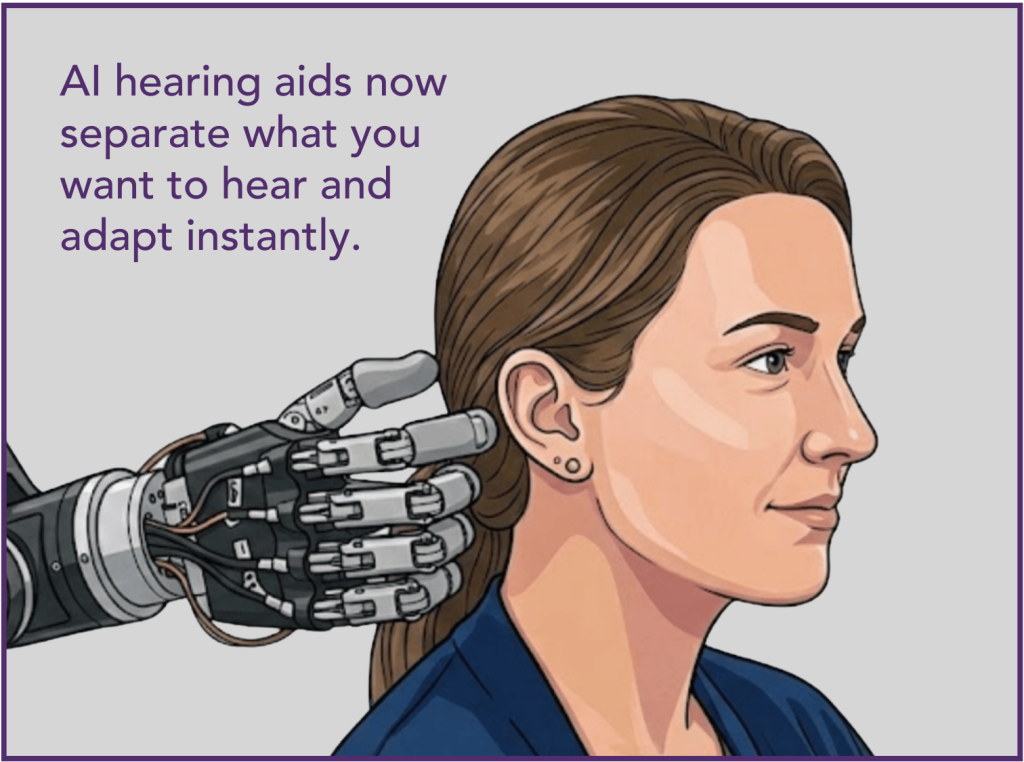
At this point, hearing aids with AI intelligently separate what you want to hear versus what you don’t. The AI continuously analyzes your environment to adapt in real time to patients’ needs.
A March 2024 study found that DNN-powered noise reduction outperformed traditional noise reduction techniques, and a 2025 follow-up field research study found that DNN improved interference control. For patients with cognitive load and mental fatigue that lead to conditions like Alzheimer’s, DNN-powered hearing aids are a welcome relief.
Some AI-powered hearing aids also allow audiologists to make remote adjustments to your devices based on patient feedback or data collected on the device. If you’re travelling or live far away from your audiologist, this ensures you get the essential fine-tuning you need for the best experience with hearing aids.
That being said, not all AI hearing aids are the same. Only a few products on the market offer real-time AI processing, which means it’s even more important to work with your audiologist to identify the best hearing aids for your situation.
4 Common Myths About AI in Hearing Aids
With “AI-powered” marketing language all around us, it’s harder than ever to understand what’s real and what’s fake when it comes to your hearing aids. Here are some of the most commonly believed myths and what the evidence actually proves.
Myth: All AI hearing aids think and adapt in real-time while you wear them.
The reality is that most hearing aids use AI during the development and training phase (i.e., before you purchase them), not while you wear them. There are a few products that offer real-time AI processing, but for the majority of hearing aids on the market, all of the AI tools are developed before your purchase.
But that isn’t a bad thing, as the AI algorithms are genuinely effective in providing an excellent hearing aid experience.
Myth: AI hearing aids automatically fix my hearing without the need for an audiologist.
The diagnostic experience and fine-tuning that comes from working with an experienced audiologist is the difference between a good and a bad experience with your hearing aids.
Audiologists ensure everything fits correctly and that the hearing aid is programmed correctly for your specific hearing loss.
Myth: More AI features mean better hearing.
Studies and tests show that while AI features work well, they aren’t universally better in every situation. Those with quieter daily routines probably don’t need adaptive technologies, unlike folks working in more chaotic sound environments.
As with any hearing aid, work with a trusted audiologist to ensure you get the right hearing aid for your sound environment.
Myth (mostly: AI hearing aids are always listening to my private conversations.
AI-powered devices use strict security measures to protect your personal information, with many newer hearing aids processing data on the chips themselves rather than sending audio to the cloud.
But one study revealed that hearing aids were broadcasting patients’ names over Bluetooth without users’ ability to change them. There are also some inconsistencies in how data is governed. Our recommendation is to ask your audiologist about how your data is stored, processed, and shared.
Do You Need AI In Your Hearing Aids?
When surrounded by AI marketing, the question becomes, “Do you need AI for your hearing aids too?”
The answer, unfortunately, isn’t as simple as yes or no; the truth lies in what environments you spend your time and what sort of hearing problems you have.
Almost all research universally agrees that AI in hearing aids helps with noise reduction, specifically in situations where you need to understand what someone is saying over competing background sounds.
A 2025 study published in Frontiers in Audiology and Otology evaluated DNN-based processing across seven real-world acoustic environments, including bars, restaurants, shopping malls, and construction sites, finding measurable improvements in both speech recognition and listener preference when AI-based noise reduction was active.
If these hearing aids reduce cognitive load, there’s a good chance they will positively affect brain health outcomes. When a hearing aid reduces the strain of processing sound in noise, it potentially frees up cognitive resources.
Modern AI-powered hearing aids provide an effortless listening experience, reducing the strain often associated with hearing in complex environments. For anyone at risk, these new AI-powered hearing aids can help reduce the risk of cognitive decline.
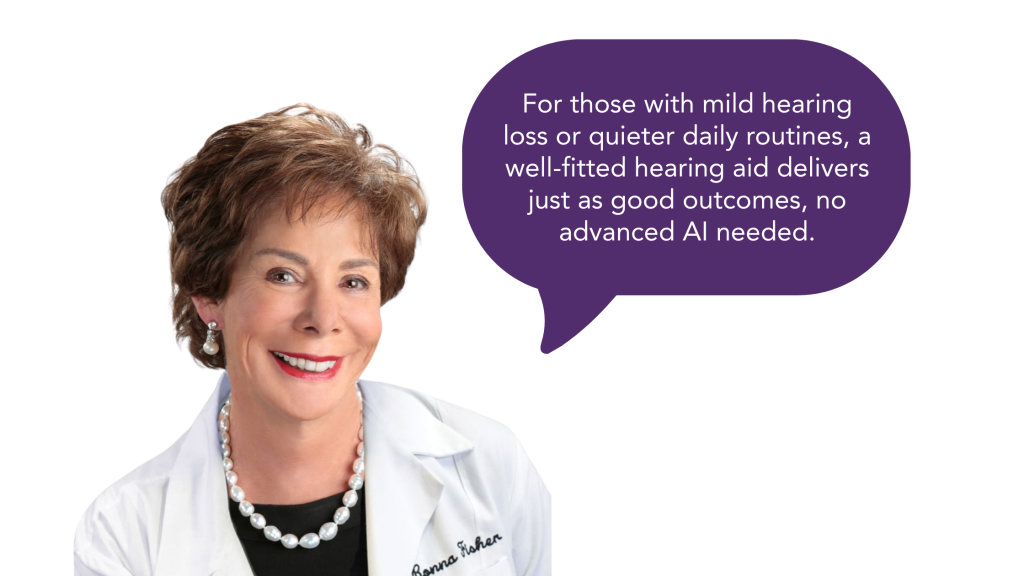
For people dealing with mild hearing loss or who spend most of their time in quiet environments, the most advanced AI isn’t as important. A well-fitted and adjusted hearing aid will deliver just as good outcomes.
Fit and Adjustments Are The Most Important Factors
More than any new technology, the most important factor in your hearing aid experience comes from the tuning, fitting, and adjustments your audiologist makes.
At Hearing Health Center, our audiologists have decades of experience working with patients of all ages, helping them get the most out of their hearing aids. When your hearing aids fit correctly and volumes are just right, you’re much more likely to continue wearing your hearing aids.
That’s why we always recommend coming to any of our five locations for fittings, adjustments, and to get any questions you might have about your hearing aids answered.
Having Trouble Hearing? Schedule Your Appointment at Hearing Health Center Today.
Having trouble hearing during conversations? Feel like social gatherings are getting harder and harder? Book your appointment online with Hearing Health Center for a free comprehensive hearing exam. An audiologist on staff performs a full exam and provides you with the information you need to get your hearing back on track.
Schedule your appointment today!
Have you ever experienced a mysterious crackling sound haunting your ear, seemingly attacking you out of the blue?
If so, you may be wondering about this irritating sound and if you should be concerned about it.
This blog will unveil the secrets behind this peculiar yet annoying sound.
Let’s dive into the captivating journey of crackling sounds in the ear, understanding what they are, the early signs, and the treatments to explore.
What Is Crackling In The Ear?
Crackling in the ear symbolizes a peculiar sound similar to the crinkling of paper or the rustling of leaves. It can be annoying and even unnerving if it happens frequently enough.
We often refer to it as a clicking, popping sound in the ear or a persistent snapping noise. These noises make it difficult to focus on the work or their surroundings.
Causes include:
- Eustachian tube movement
- air pressure fluctuation
- excessive earwax
- muscle contractions
While harmless, ear crackling can be bothersome and may indicate an underlying issue that warrants further investigation.
Struggling with popping in your ear? Schedule your free consultation with Hearing Health Center today.
The Three Biggest Causes of Crackling in Ear
Sometimes the crackling in your ear is coming from an area near the ear, or a more specific medical condition. If the crackling conditions continue, consider one of the following:
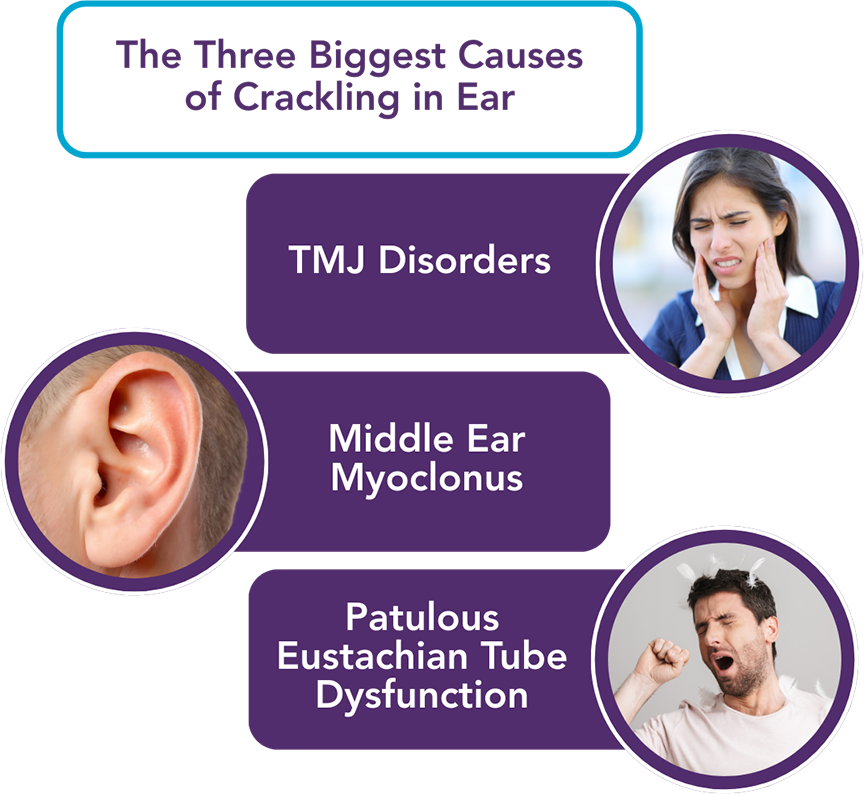
TMJ Disorders
Your temporomandibular joint (TMJ) sits right next to your ear canal.
If your jaw is misaligned or you’re dealing with teeth grinding, the clicking you hear is actually your jaw joint popping.
Middle Ear Myoclonus (MEM)
Think of this as a “twitchy eye” but inside your ear.
Tiny muscles (the stapedius or tensor tympani) can sometimes spasm rhythmically, causing a seemingly random thumping or clicking noise.
Patulous Eustachian Tube (PET) Dysfunction
Most of the time, the Eustachian tube remains closed and only opens when you swallow or yawn.
For people with PET Dysfunction, the tubes stay open constantly, causing “autophony,” a condition in which your breathing sounds echo or distort, often accompanied by crackling.
Five Early Signs Of A Crackling Sound In The Ear
Early signs of ear crackling can vary depending on the underlying cause.
Listed below are five common early signs that you must watch out for in case of something more serious going on:
- Popping & Clicking: You may notice popping or clicking sounds in one or both ears, similar to popping bubbles.
- The Sensation of Pressure: You might feel pressure in the ear, as if something is blocking it.
- Mild Discomfort: You may experience slight discomfort in the ear, which can be referred to as a sensation of mild pain or extreme itchiness.
- Fluctuation in Hearing Sensitivity: You might observe subtle changes in your ability to hear or even a slight reduction in hearing sensitivity, especially in the affected ear.
- Temporary Hearing Loss: Frequent episodes of temporary hearing loss or muffled sounds in your affected ear lasting for short periods are early signs of ear crackling.
It is essential to remember that these signs vary depending on the underlying causes.
If you experience any of these signs or have concerns about ear crackling, it is advised to consult medical professionals, including ENT specialists, for a proper diagnosis.
How To Preserve Your Ear From Crackling Sounds?
To preserve ear health and minimize crackling sounds, the best approach is simple ear health maintenance.

First, keep your ears clean and prevent excessive earwax buildup. Excessive earwax is a key contributor to the crackling sound and could lead to hearing damage if not treated appropriately.
If you work in a noisy environment or just love concerts, wear protective headphones (or safety earbuds). This is another instance of something that may not bother you in the moment but could cause serious injury later in life.
During activities like flying or swimming/scuba diving, it is advised to yawn or swallow to equalize pressure in your ears.
Also, this is very important. Do not use cotton swabs, car keys, or any other object to clean your ears.
Wonder why? Other than the obvious, any foreign object inserted into your ear pushes earwax deeper, causing damage to your delicate structure.
Lastly, drink enough water to maintain proper Eustachian tube function, facilitate equalization of pressure, and minimize the likelihood of crackling sounds.
How To Get Rid Of The Crackling Sound In The Ear?
The different treatments for the crackling sound you’re hearing really depend on the underlying cause. That’s why your audiologist will first focus on finding the reasons why it’s happening, then present you with a treatment plan.
One of the most common treatments begins with earwax removal. An audiologist will perform ear irrigation or use specialized tools to remove the buildup in a safe manner.
If you have issues caused by blockages, nasal congestion, or improper pressure equalization, the next step might be Eustachian Tube Dysfunction Management.
In case of ear infection or inflammation, antibiotics or anti-inflammatory medications should be prescribed to alleviate symptoms and resolve the underlying problems.
If the crackling sound is accompanied by tinnitus, treatments like CBT (Cognitive Behavioral Therapy), Sound Therapy, and TRT (Tinnitus Retraining Therapy) are recommended to help manage the symptoms.
For cases where muscle tension or spasm contributes to the crackling sound, techniques such as physical therapy, jaw exercises, and relaxation exercises help reduce tension and offer immense relief.
The best way to address ear crackling is to identify the underlying cause and work with your audiologist to resolve it.
When to Worry About Crackling in Your Ear
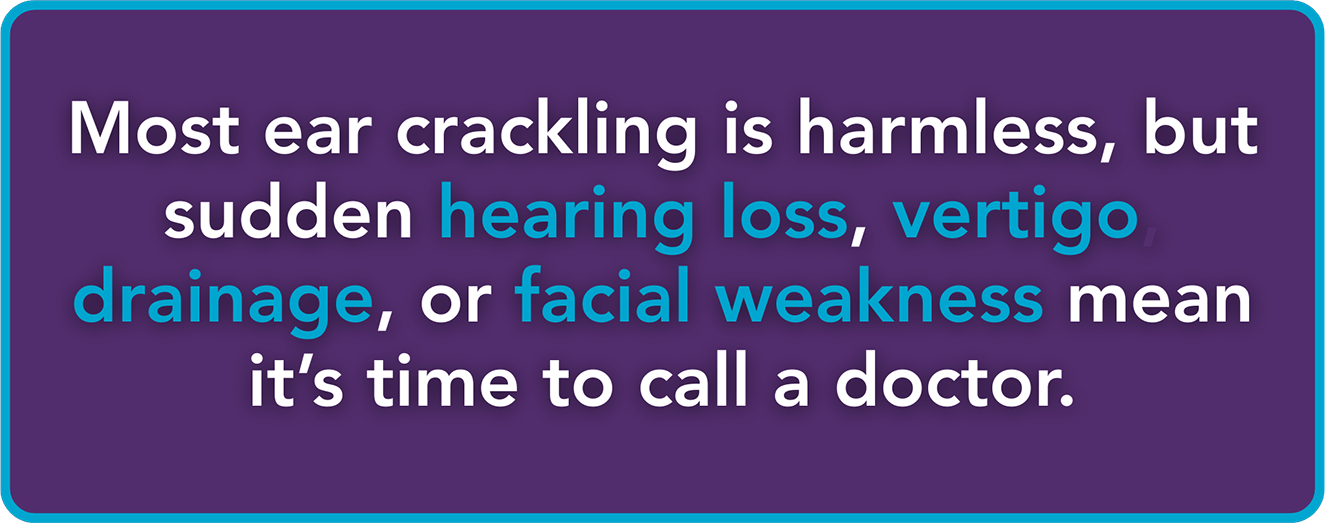
While most of the time, nothing to worry about, if you suddenly experience any of these additional symptoms, it is time to call a doctor right away.
Sudden Hearing Loss
If everything suddenly goes quiet, this becomes a medical emergency. The sooner you get treatment (often within 48 hours), the better the chance of recovery.
Vertigo
Vertigo is when the room starts to spin, or you become dizzy. If you are suffering from this, it might mean you have an inner ear infection or Vestibular issues that, when left untreated, can cause long-term hearing problems.
Drainage
It can be unsettling to see blood, pus, or clear fluid leaking from the ear canal, and it’s time to call a medical professional because this is an emergency.
Facial Weakness
Any drooping or facial numbness can be a sign that the nerves running near the ear are under significant stress. You should call a doctor immediately if you notice these signs.
How To Safeguard Young Kids Against Loud Noises?
Studies have shown that long-term hearing damage isn’t always the result of a single instance, but rather the combination of loud noises over significant periods of time. Since you don’t lose all of your hearing at once, you’ll gradually lose your ability to hear if you don’t get regularly scheduled hearing checks.
Step one is to limit exposure. Minimize exposure to loud sounds, especially during fireworks, machinery, and TV time. Also, offer properly fitted ear protection, such as earplugs or earmuffs to kids when in a noisy environment.
Second, make sure all electronic devices, media, and toys have volume limitations. The goal is to avoid prolonged exposure to loud noises.
You may also consider creating separate quiet areas at home for young kids where they can relax and take a break from the noise.
By practicing these measures, parents can safeguard their kids against damage caused by loud sounds.
Need Your Hearing Checked? Contact Hearing Health Center Today!
If you experience ear crackling with no pain, consult an ENT specialist or other medical expert to identify the issue and recommend treatment. It could be an earwax build-up, managing Eustachian tube dysfunction, or treating infections.
Consult our professionals at Hearing Health Center to get proper treatment, including earwax removal. We have a team to help patients find the treatment that best suits their unique hearing needs.
Hearing ability is a precious gift that enriches us and helps us connect to the world. Unfortunately, due to hectic lifestyles and impractical choices, hearing loss has become increasingly common, affecting all ages.
But the good news is that many of these cases of hearing loss are preventable. By practicing healthy choices and taking proactive steps, you can safeguard your hearing health for ages to come.
What Is Hearing Loss?
Hearing loss refers to a reduced or diminished ability to pick up on sounds or even understand them. Its severity can range from minor to extreme, depending on the underlying reasons.
This includes ear infections, prolonged exposure to loud sounds, hereditary predisposition, head injury, side effects of a medicine, and aging.
The key to preventing or slowing hearing loss is to understand what is “loud” and to limit exposure. Understand that the louder the volume, the less time you can listen to it before it harms your hearing.
Why Is Hearing Loss Affecting People at Younger Ages?
There are myriad reasons why hearing loss appears to affect people now at earlier ages.
Loud environments and prolonged exposure to extreme volumes, such as recreational activities, concerts, and the constant use of personal audio devices at high volumes, are contributing significantly to hearing damage among young people.
With headphones becoming an everyday staple, constant exposure to loud music is slowly affecting people’s hearing. Add in how some occupations (construction sites, manufacturing facilities, aviation, transportation, and entertainment) regularly expose people to high levels of noise, and young people are more likely than ever to experience hearing loss.
Some medical conditions, such as genetic disorders, infections, and autoimmune diseases, can also lead to hearing loss, especially in younger individuals.
Genetic predisposition can make individuals more prone to hearing issues.
Thanks to cutting-edge diagnostic tools, more and more people are now aware of the importance of hearing health.
This includes improved identification and early detection of hearing loss. You can schedule a free comprehensive hearing exam at Hearing Health Center today.
What Are The Early Signs of Hearing Loss?
It is essential to note the early signs, although they vary by individual or specific type of hearing loss.
If you notice any of these signs or have concerns, connect with the Hearing Health Center team to avoid more serious, long-term damage.
Difficulty Deciphering Conversations
One of the early signs of hearing loss is trouble following conversations, especially in noisy environments.
You may find it challenging to understand what others are saying, leading to repeated questions or requests for clarification.
Increasing Volume
Turning the volume up or asking others to repeat themselves if you find it too loud or extremely loud indicates the onset of hearing loss.
Gradually increasing the volume is a major early sign that most people do not recognize.
Withdrawal from Social Events
Individuals with hearing loss often withdraw from social gatherings or group conversations.
This is the result of difficulties understanding conversations, which then leads to feeling frustrated, embarrassed, and even isolated.
Eventually, individuals will avoid situations that demand extensive communication.
Tinnitus
The perception of ringing, buzzing, or other ghost sounds in the ears is associated with hearing loss.
If you often experience tinnitus, especially with other symptoms such as difficulty hearing, it is advised to have your hearing checked.
6 Ways To Protect Yourself From Hearing Loss
1. Protect Your Ears Against Noise
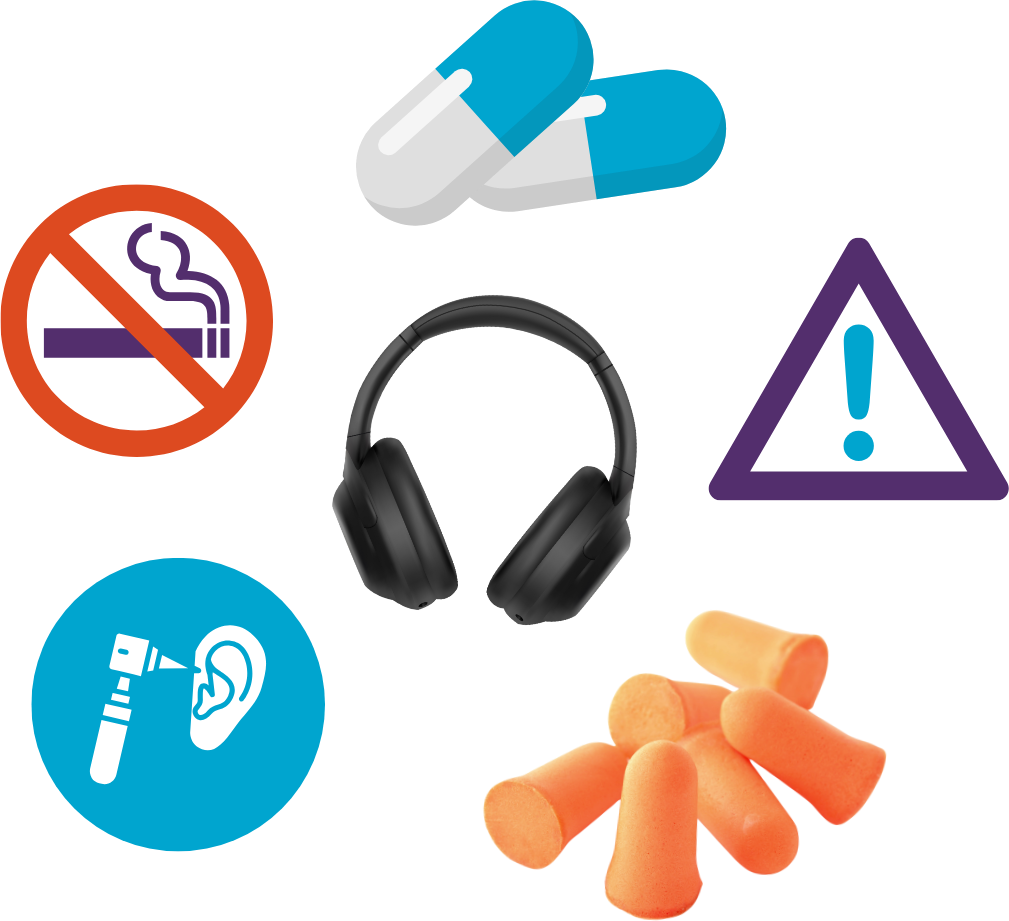
Wear earplugs or muffs to reduce the impact of excessive sound at concerts or sporting events.
When at home, keep the volume at a normal level, especially when listening to music or watching TV, and use headphones.
2. Take Breaks from Noise
Taking regular breaks from noise is advised, especially in loud environments or when wearing headphones.
If you work at a loud site or in a noisy setting, take proper breaks in quieter areas to allow your ears to recover.
3. Be Cautious with Headphones
While earbuds and headphones entertain with convenience, don’t forget that they can be harmful, especially when misused.
Limit your use of headphones or earbuds, and when you do use them, keep the volume at a reasonable level.
Consider using noise-canceling headphones, which block external noise, so you can enjoy music without turning up the volume.
4. Follow a Healthy Lifestyle
Lifestyle factors influence your hearing health.
Avoid smoking; it can contribute to hearing loss. Manage chronic conditions like hypertension and diabetes – they affect your auditory system.
Stay physically active and practice a balanced diet to promote overall well-being, including your ears’ health.
5. Be Cautious with Medicines
Certain medications, also known as ototoxic drugs, damage your hearing.
This means if you are prescribed medication, consult your healthcare professionals about potential side effects on your hearing.
Be vigilant and report any effects or changes in your hearing during or post medication.
6. Schedule Regular Hearing Tests
Like any other routine medical check-up, regular hearing evaluations play a key role in detecting potential hearing loss early.
Schedule an appointment with a trusted audiologist or hearing healthcare expert to monitor your hearing health and address your concerns.
Ready To Protect Your Hearing? Schedule Your Free Hearing Exam Today.
Hearing loss can happen at any age and for many reasons, but fear not.
You can avoid noise-related hearing loss by getting annual hearing health testing, avoiding ear-damaging loud sounds, wearing ear protection muffs around loud noises, and practicing safe headphone usage.
Schedule your free hearing health exam at Hearing Health Center today.
Hearing loss costs a lot more than just your hearing. Every single day, patients walk into our practice not realizing how much they’ve lost financially, physically, and emotionally due to ignored hearing healthcare.
To help patients better understand what untreated hearing loss costs them, we put together this guide that explains how hearing loss impacts every single aspect of your life.
If you’ve ignored your hearing health, or want a check up, schedule a free comprehensive hearing exam with Hearing Health Center today.
How Common is Hearing Loss?
Hearing loss is remarkably common amongst adults. Approximately 15% of adults aged 18 and over in the United States report some hearing difficulty. That’s a little over 37 million people.
Age is the strongest predictor of hearing loss, with the highest percentage occurring between the ages of 60 and 69. Another key factor in hearing loss is exposure to loud workplace noise. 18% of adults have hearing loss at speech frequencies in both ears if they report loud workplace noise, while only 5% have hearing loss if they don’t.
Tinnitus is a concern as well. Around 10% of the adult population in the United States has experienced tinnitus, rising to 14% when worldwide totals are included.

One of the trickiest parts of dealing with hearing loss is that it’s often gradual. That means over time, you slowly lose your hearing until one day, poof, you recognize you can’t hear as well as you once did. Subconsciously, your brain might do more lip-reading, or strain so you don’t have as much of an idea how much you’re being affected until it’s too late.
Some physicians do not routinely perform hearing exams during physicals, which means gradual hearing loss could be occurring without you even realizing it.
The best and most effective way to gain a better understanding of your hearing health is to schedule an exam with a trained audiologist. At Hearing Health Center, our team performs a comprehensive hearing exam that gives you a clearer picture of your hearing health and the steps you can take to prevent hearing loss and reduce long-term costs.
The Monetary Costs of Hearing Loss
The 83% of people on Earth suffering from untreated hearing loss account for costs of nearly $980 billion per year. That total is around 6 % of GDP per capita.
According to a study led by researchers at the Johns Hopkins Bloomberg School of Public Health, “older adults with untreated hearing loss generated an average of 46 percent more in total health care costs over 10 years versus those who don’t have hearing loss.” In dollars, that’s a little over $22,000 over 10 years.
Broken down further, people with hearing loss incurred nearly 26 percent more total health care costs over two years than those treated.
But what is most costly is the hospital stay data. After 10 years, patients with untreated hearing loss were hospitalized 50% more often; 44% of those people were at higher risk of hospital readmission within 30 days, and had about 52 more outpatient visits than those without hearing loss.
Another study calculated the extent to which untreated hearing loss affected household income. They found that people with the highest level of hearing loss earned $12,000 less per year than those with minimal to no hearing loss.
Simply put, the data shows that untreated hearing loss means you’ll earn less and spend more on healthcare costs in the future.
Don’t let untreated hearing loss cost you your hard-earned money; schedule your hearing exam today.
The Health Costs of Hearing Loss
The most obvious cost of hearing loss is, of course, the inability to hear. But what most patients do not realize is that their hearing health affects the entire body, including brain function, balance, and overall well-being.
When someone loses their hearing, they become much more at risk of dementia. A 2020 report lists hearing loss as one of the significant contributors to dementia, as hearing loss requires your brain to work extra hard to understand and fill in missing gaps.
The more your brain works on these tasks, the more energy is taken away from thinking memory systems. Another possibility is that hearing loss causes an aging brain to shrink faster, thus leading to dementia.
As of today, hearing loss is attributed to around 8% of all new dementia cases, or around 800,000 every year.

Another danger of hearing loss is its effect on someone’s balance. The vestibular system in your ear helps detect the head’s positioning and the space around you. Hearing loss can negatively affect these neurons and sensors, thereby increasing the risk of falling.
There are two additional factors to consider.
The first is that auditory input is lowered with hearing loss, which then affects the brain’s ability to understand spatial information. Without being able to comprehend the area around you fully, you end up more likely to slip or fall.
Another aspect to consider is that, because your brain is working harder to understand sounds, it leaves less space to understand your surroundings. Your brain is focusing too much on one thing, leaving you more likely to ignore the space around you.
Your hearing health is more than just that: proactive action to protect yourself can help prevent serious, long-term issues.
The Social and Emotional Costs of Hearing Loss
Loss of hearing comes at a price for your mental health as well. Nearly 33% of adults 70 or older suffer from hearing loss that impacts their daily communication, which, as a result, leads to further isolation.
This isolation then leads to depression and an overall decrease in your well-being.

People who are hard of hearing become embarrassed by constantly asking others to repeat themselves, or frustrated when talking with family members, when they can’t understand them. Studies have shown that once these incidents occur frequently, people isolate themselves, leading to less-happy lives and even shorter lifespans.
There’s also the lesser-known effect of hearing loss: missing nuance in meetings and how that impacts work promotions.
Between isolation and the negative emotional impacts, it’s an easy solution to start focusing on your hearing health as soon as possible.
How Can Early Treatment of Hearing Loss Help You?
Early interventions for hearing loss limit many of the short- and long-term negative health and financial effects that cost people thousands of dollars each year.
Financially, you are not only more likely to make money with early hearing loss interventions, but you’re also less likely to spend money on hospital visits due to injuries sustained as a result.
There’s also the financial savings that come with being less likely to fall and injure yourself, and lowering the risk of dementia or other brain-related diseases.
Hearing aids are statistically more likely to lessen the likelihood of social isolation, thus reducing the chances of dementia. While treatment has not been proven to to prevent dementia, early research is promising.
Early interventions and treatment give people back the life they deserve, so don’t wait any longer and get your hearing checked today.
Need a Hearing Test? Contact Hearing Health Center Today!
Struggling with your hearing lately? Want to get checked early before something goes wrong?
Call Hearing Health Center today and schedule a free comprehensive hearing exam to get you started on your hearing health journey.
Don’t let hearing loss cost you your life, schedule your appointment today.
For more than 40 years, Dr. Ronna Fisher has helped people hear the moments that matter. Conversations at the dinner table. A grandchild’s laugh. The simple comfort of feeling connected again.
Now, her story is front and center on the cover of Highland Park Neighbors. In this feature, Dr. Fisher shares the personal loss that led her into audiology, the breakthroughs that shaped Hearing Health Center, and why hearing care has never been just about devices. It’s about staying present in your life and the people you love.
Read the full Highland Park Neighbors feature below or by clicking here.
It’s time to review your benefits and coverage as the end of the year approaches. Maximizing your tax-free dollars and planning for the new year is a smart move.
However, with FSAs, HSAs, and health insurance, the situation becomes confusing quickly. This brief guide helps explain the various health spending accounts and what you can expect in terms of hearing health.
If you have any questions whatsoever, don’t hesitate to reach out to Hearing Health Center, and a member of our staff can help you navigate your hearing benefits.
Flex Spending Accounts for Hearing
There are only a few days left before you lose out on any leftover money in your Flex Spending Accounts (FSA).
One of the key differences between FSAs and HSAs is that any money left over in the former goes away once January 1st rolls around.
Now, of course, that comes with an asterisk. For 2025 going into 2026, you are allowed to carry over a maximum of $660 in your FSA, but your employer is not required to include this benefit for their accounts. It’s best to check with them to understand your specific policy.

But even with that, expect any remaining tax-free money in your FSA to disappear at the end of the year.
Your FSA funds can be used towards:
- Hearing exams and evaluations
- Hearing aids (both prescription and over-the-counter models)
- Hearing aid fittings and adjustments
- Hearing aid batteries and supplies
- Repairs and maintenance for hearing aids
So, if you have been missing parts of the conversations, struggling to hear the punchline of the joke, or frequently asking your boss to repeat what they said, an investment in your hearing health might be the smartest decision you make this year.
Health Savings Accounts for Hearing
The good news for people with Health Savings Accounts (HSA) is that any money you have left over rolls over to the following year.
While HSAs are typically only available to folks with a high-deductible health plan, individuals can contribute $4,400 for self-only coverage and $8,750 for family coverage.

If you are 55 and over, you can also contribute an additional $1,000.
Due to the carryover and high contribution limits, taking care of your hearing health with HSA funds makes sense.
You can use your HSA to pay for:
- Comprehensive hearing exams or audiological evaluations
- Prescription hearing aids (all models and brands)
- Over-the-counter hearing aids (now allowed under the 2022 FDA rule)
- Hearing aid fittings and adjustments
- Hearing aid batteries and replacement parts
- Hearing aid repairs and maintenance
Spending time communicating, sharing, and laughing with your wife, kids, and friends is the most important part of your life.
It may be time to heed their advice and have your hearing checked.
Insurance Benefits for Hearing
When it comes to health insurance and your hearing health, the answer to ‘what are the benefits’ really depends on your plan.
Just like with dental and vision, most health insurance plans do not typically cover hearing treatment or hearing aids.
However, hearing problems are on the rise and occurring much earlier in life. The majority of individuals with difficulty hearing and communicating are under the age of 65.
Some insurance plans are beginning to offer partial or complete coverage for hearing aids, fittings, and exams, but this coverage varies depending on your individual circumstances.
Our lobbying efforts with health insurance companies are leading to a change in hearing benefits. Let us help you check your plan and coverage. You might be pleasantly surprised.
We can help you maximize the benefits of your insurance coverage.
Need Help with Your Hearing Health? Call Hearing Health Center Today.
Communication is a cognitive function. Cognitive functioning, along with memory and balance, deteriorates rapidly when your brain doesn’t get the right amount of sound, can’t process the sound, and can’t interpret the sound it receives.
Even if you do not have flex or health savings accounts and your insurance does not include hearing benefits, do not ignore symptoms or suspicion of a hearing problem.
A hearing problem is ultimately an indication of a serious cognitive problem. Call Hearing Health Center or schedule an appointment online today.
I did the research so you don’t have to.
Understanding Traditional Medicare vs. Advantage Plans
Traditional Medicare
Traditional Medicare is operated by the government and is a combination of Medicare Parts A (hospitalization) and Parts B (Physicians and testing), and Part D (drug plan). Traditional Medicare covers 80% of your health care costs. To cover the remaining 20%, you must buy a Medigap, or supplemental, policy.
Cost
The cost for traditional Medicare for 2026 is estimated to be $206.50 monthly. The cost for a supplemental plan (G Plans), the most popular supplemental plan costs $100-$200/month.
Traditional Medicare
The Good News
- You cannot be turned down for the best, most comprehensive (and expensive) plan (currently Plan G), even if you already have health issues.
- Almost all doctors and hospitals accept Traditional Medicare. You have the widest access to health providers.
- Out-of-pocket costs are limited to the annual Park B deductible, estimated at $288 in 2026.
The Bad News
- The premium for a supplemental policy is more than for Advantage Plans.
- You still must buy a separate drug plan (Part D).
Advantage Plan
Advantage plans are operated by private insurance companies that contract with Medicare.
Cost
You still must pay the cost for traditional Medicare (estimated 2026 premium of $206.50/month.
Advantage Plans
The Good News
- They often include additional benefits (dental, vision, hearing), that traditional Medicare does not cover.
- They usually include coverage (Part D), which is extra in Traditional Medicare.
The Bad News
- Many doctors and hospitals are dropping out of Advantage Plans because of declining reimbursement and paperwork nightmares.
- They require permission for testing and limited access to physicians and hospitals that are part of the group. Going out of network can mean higher costs or no coverage at all.
- Prior authorization is required for many services, which can delay or prevent needed care.
- Although premiums may be lower, Advantage Plans have higher co-payments, deductibles, and out-of-pocket maximums (in 2025, the out-of-pocket maximum for Medicare Advantage Plans is $9350 for in-network services).
- They may not offer coverage outside of their service area, which can be a problem when you travel.
Bottom Line
- Open enrollment occurs from Oct. 15th to Dec. 7th. This is the only time you can choose or change plans.
- Check the notice your current plan sent you. How much have premiums and costs risen? Are your doctors and hospitals still in the Plan?
Resources to help you:
- Medicare.gov
- eHealth.com
- Boomerbenefits.com
- For personalized help, make sure you use a licensed individuals – not from an Advantage salesperson who earns a larger commission for selling those plans.
The following article from the Chicago Tribune tells how hearing loss can create life-altering anguish for aging parents and their extended families, most of which can be avoided or greatly diminished by testing and treatment.
Louise Andrew: I watched male loved ones deny their hearing loss. Left untreated, it devastated their lives.
Purging closets bursting with hideous ties reminded me of how difficult it is to “gift” a father with something of value on Father’s Day.
I had a very close relationship with my father and both grandfathers, who supported and protected me always. Fatherly and grandfatherly support is a profound gift for any daughter or granddaughter. I am eternally grateful for these mentors and wish their loving influence had persisted longer.
All my fathers had excellent longevity. But what could have helped them to live even longer, more engaged and fuller lives? Here is what I wish I had given them: Release from the need to appear to be consistently strong, self-sufficient and invincible. The ability to acknowledge and adapt to advancing age and associated infirmities and the courage to admit the inability to solve every problem alone. I wish I could have gifted them the willingness to seek and use help when indicated. To release them from a belief that seeking help means you are “less of a …,” whatever it is, that you feel you must always and consistently be, as a father and as a man.
The gift I would bestow on all fathers is the courage to address the curse that took the intellect of my father, one grandfather and my father-in-law: age-related hearing loss, also known as ARHL. Not being able to hear or properly process information made these men first defensive, then blameful, isolated and in denial. Eventually it rendered them less companionable and less interesting to people around them, ignored and, ultimately, avoided by those who might have helped them prevent the dementia that resulted from ARHL.
More than 460 million people worldwide suffer from disabling hearing loss, according to the World Health Organization. In the U.S., hearing loss affects one-third of those 65 to 74 years old and nearly half of those older than 75, the National Institute on Deafness and Other Communication Disorders reports. ARHL is the most common remediable cause of cognitive impairment, falls and depression. Johns Hopkins researchers found up to a fivefold increased risk in older adults of developing cognitive impairment, including dementia, when significant hearing impairment remains unaddressed.
Although I owe all of my education to my financially astute grandfather, his stubborn refusal to address hearing loss ultimately led to social isolation. As fresh memories faded, repetition of the same stories made him less engaging and, ultimately to some, the object of derision. The exact same denial in my once-gregarious father led to ostracism in his retirement community, contributing to his death by a stroke after multiple falls. My even more sociable father-in-law developed a form of dementia that was completely surgically curable, but the hearing loss he refused to address made him so uninteresting to be around that no one realized what was happening until it was too late for surgery.
By contrast, my physician grandfather, who used hearing aids, practiced medicine until he died at 81.
If you have ARHL, you may be thinking, “If everyone would just come closer, put down their gadgets, look directly at me, stop mumbling and enunciate more clearly, there would be no problem.” Right?
Wrong. Incoming students in an audiology program were required to wear earplugs for their first three days. That first day, they could ask people to repeat what they had said. By the second, students noticed their interactions became shorter and terser. By the third, people actively began to avoid them. These “hearing impaired” students were essentially being isolated. This same sequence occurs even in close and long-term relationships, albeit more gradually.
If you are beginning to experience hearing loss, your loved ones are sympathetic and supportive at first. ARHL is a disability, and it’s probably not your fault. But as it becomes more difficult to make ourselves understood, we are less likely (when communication is not truly essential) to make an effort. If we’ve brought the hearing issue up many times before, and you do not respond, you begin to seem more stubborn than fragile. ARHL is easily addressed, and yet, to a loved one, your denial of it feels as if you don’t care about your own well-being, the health of our relationship or the happiness or even safety of those who love and may depend on you.
If your father is one of the 500 million worldwide with hearing loss, try this gift: Remind him that you love him dearly and want him as a trusted adviser for as long as humanly possible. Urge him to have his hearing tested and to get hearing aids if indicated. These devices are both effective and almost invisible, and effective alternatives are also available over-the-counter.
The author, Louise Andrew, is a physician attorney, and disability rights advocate.
Consider making a free hearing ability test for your loved one.
The ear is a dark, warm, moist place…the perfect environment for growing fungi, germs, and bacteria. Hearing aids reside in this environment 13 to 16 hours/day.
Guess what? Every time you remove your hearing aid from your ear, it is loaded with fungus, germs, and bacteria.
Reinserting your hearing aids without cleaning, sanitizing, and disinfecting them can irritate the lining of your ear canals, leading to redness, swelling, itching, pain, unpleasant odors, and infections.
Here are our best tips on how to clean and disinfect your hearing aids.
Do I Have To Clean or Disinfect My Hearing Aids?
There are three key reasons why you should always clean and disinfect your hearing aids:
- Protect your ears
- Upkeep for optimal performance
- Avoid broken parts
A hearing aid, similar to an earbud or any type of headphone that sits in your ear, collects earwax, dirt, dust, and debris over time. While little bits of that won’t hurt, over time, all of those materials mixed within your ear can lead to ear infections and skin irritations.
Long-term, you might experience other ear-pain-related issues, all because you didn’t clean your hearing aids.
Like most electronics, the better you take care of them, the better they’ll work. Hearing aids are no different.
To maintain your ability to hear and the clarity with which sound comes through your hearing aid, you must clean it regularly. Debris (especially earwax and moisture) clogs microphones, receivers, and vents.
And of course, when your hearing aids start to break down, they just won’t last as long. Well-maintained hearing aids can last anywhere from 3 to 7 years, but if you aren’t keeping up with cleaning, that time will shorten quickly.
While Hearing Health Center is always ready to help with any repairs you might need, we also want your hearing aids to last as long as possible to save you money and protect your hearing.
How To Clean Your Hearing Aids
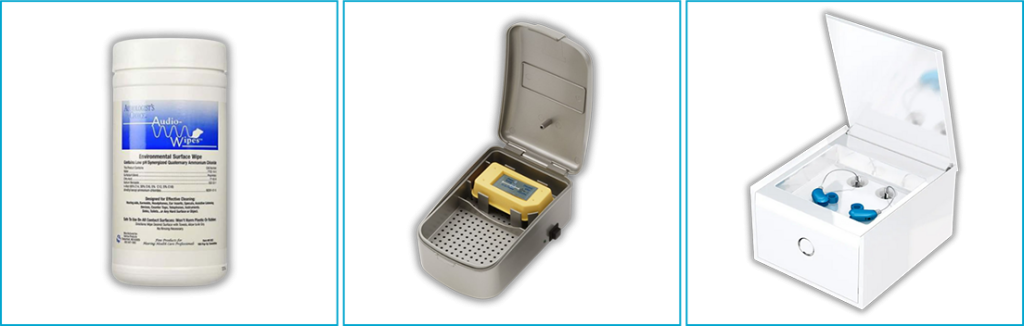
Step 1: Wipe with a non-alcohol sanitizing wipe (like Audio Wipes).
Step 2: Keep your hearing aids in a drying system (Dry and Store) or the new (PerfectClean) explicitly designed to sanitize and pull out the moisture inside the hearing aids that accumulated from your ear.
Drying systems utilize desiccants and heated, moving air to dry the hearing aid both inside and out. The built-in ultraviolet light sanitizes and kills germs while removing moisture.
Using a drying kit will:
- Increase the life of your hearing aids
- Prevent costly repairs
- Increase battery life
- Maintain the peak performance of your hearing aids
- Relieve itchy ears by killing germs
**Pro Tip!** Never use alcohol on hearing aids or ear molds. It will ruin and erode the surfaces and special plastic materials used in the manufacturing process. Alcohol will also damage the delicate components of the hearing aid.
What NOT To Do When Cleaning Your Hearing Aids
1. Do NOT use household cleaning products to clean hearing aids.
It might be tempting to grab something underneath your sink to clean out your dirty hearing aids, but let me stop you there.
Not only could the chemicals cause your hearing aids to malfunction, but certain products may also harm your ears.
Instead, stick to cleaning products specifically designed for use with hearing aids. If you have any questions, don’t hesitate to ask a member of the Hearing Health Center team.
2. Do NOT use sharp objects to clean hearing aids.
The products around your house, such as pins, needles, or even pencils, should never be used to clean something out of your hearing aids.
If an object is sharp, you have a good chance of puncturing and scratching the inner workings of your device, which increases the likelihood of breakage.
3. Do NOT submerge hearing aids in water to clean them.
We know it sounds obvious, but hearing aids are not waterproof. They might be water-resistant, but that isn’t the same thing. Instead, use a damp cloth with hearing aid-specific cleaning products to wipe them down.
4. NEVER use compressed air to clean hearing aids.
Your hearing aids are fragile, so a single blast from a can of compressed air could cause a lot of problems. The power is too much for the inner workings of your hearing aids to function, so whatever you do, do not use compressed air.
Need Help with Your Hearing Aids? Call Hearing Health Center Today.
Whether your hearing aids need tuning up or you’re in the market for a new pair, the team at Hearing Health Center has you covered. Our experienced audiologists conduct a comprehensive hearing exam to ensure your hearing aids are a perfect match for your needs.
Don’t delay; call Hearing Health Center or schedule an appointment online today.